Today I crossed the channel from mainland Kenya to the old Swahili Island of Lamu with two young Kenyan men. It was their first time visiting the old Swahili town, though I had been a tourist there twenty years ago. I already had a sunburn from going by boat two days ago to the Lamu airport – The airport is on Manda Island (which used to also have a town until they ran out of fresh water) so now it consists of the airport only, with no cars around. I think cars aren’t allowed on any of those islands. I love that the only engines you hear are speed boats. You leave the airplane, get your bags and walk down to a boat to go across the water.
Here’s pulling up to the dock in Lamu:

Andrew and I went to pick Ben up from the Lamu airport the day before yesterday and the 45 minutes under the fierce sun made me sick enough to go home and have diarrhea all night. Luckily, I picked some fresh aloe vera at the airport and have been using it on my skin ever since so I think it won’t peel. Yesterday I did nothing because I was recovering from heat exhaustion, and today I knew enough to put on a no nonsense 40-times sun protection before going to Lamu Island on a boat.
We are all three staying in Mokowe town on the mainland of Kenya. It’s cheaper and the governor of Lamu county has his office here and of course the main port is here (to get all the essentials from the mainland to the islands). Tourists typically only see the lovely historic town on the Island and then go out the beach resort of Shelley on the far side of the island to get away from it all and eat crabs. Mokowe is the less glamourous, more professional town.
The Historic town was originally called Amu but has become known as the town of Lamu on the Island of Lamu in the county of Lamu tucked up next to Somalia. It has an illustrious history, though it has always been governed by outsiders it was a major port of call in the important Swahili trade route and thus VERY cosmopolitan: first the Omanis ruled all down the coast as far as Madagascar, than the Zanzibaris ruled up as far as Oman; than the British conquered Mombasa and Malindi, The Germans set up the first post office in Africa here on this island, and finally Kenya 😊 govern this island complete with Nairobi businessmen making a mint off the tourism. As airplanes take over international travel the Swahili coast is becoming a quaint backwater, but the locals are proud of their intact traditions and their long history of trade and education.
I have been staying in Malindi town for a few weeks; it also is historic in a different way, but lately it is mostly Kenya’s party beach town. Vasco de Gama lived in Malindi for a while and the 600 years ago and the oldest catholic church in Africa sits peacefully by the beach near a mosque and a Hindu religious center there. There is also a Muslim cemetery very near and an old, abandoned Swahili building that the locals swear is so possessed of demons that they periodically feed it goats.
For the past fifty years the Italians who evacuated Mogadishu in the 1970s have been living in Malindi bringing it the name of sin city. But they are getting very old, and since they never learned Swahili or English. Malindi is being taken over these days by the Nairobians.
Anyway, you can fly between the two towns, but I am trying to be like the locals, so I took a bus with Andrew. We waited over three hours in downtown Malindi for our broken-down bus – and it was Ramadan so we couldn’t buy tea – then we took the three-and-a-half-hour drive to Lamu. It is only 160 kilometers but at 32 degrees Celsius and 90% humidity, without air-con that feels far. I had my window open but not enough to get a sunburn.
The roads aren’t bad either, but it’s slow going because of police stops and postal delivery to lots of tiny towns. At one place the police wear ski masks, because they say they are scared of Al Shabaab. Mostly they just want to collect bribes I’m afraid, though people try to scare me about the Somali terrorist group. I did see the driver hand out currency at least 6 times.
The first morning in Makowe we went to the governor’s office to try to make a meeting for Terry’s colleague – Benjamin – to talk about coastal ecology. I was playing on the white privilege card to get an audience. It is very real here and it worked, but Benjamin himself didn’t arrive until later because his plane was delayed in Nairobi because of a storm. After my elevator pitch and Andrew’s authentic Kenyan banter, the Governor’s chief-of-staff kindly said he would call me later to meet with Benja.
We then went to meet the tardy Nairobian (who wants to settle on the coast) at the airport because he has never been to Lamu before. He is very interested in getting international investment to improve the coast environment around here. One thing the governor’s office did say is that Al Shabaab (the infamous terrorist group) is a last resort for disenfranchised youth around here. I wish America weren’t so busy arming them and arming the Kenyan government at the same time. But it makes the military industrial complex around the beltway of DC very rich……….
So yesterday I spoke with the chief-of-staff for the Lamu county governor to confirm tomorrow’s meeting with the new Deputy Governor of Lamu County and that is all I did. It was a big win frankly. Then I slept all afternoon, caught up a bit on emails, and we decided to go as tourists to Lamu town today…
I’m so glad I did!!!! The town, and its dirty tiny streets, is fascinating! People are very chill, and I can tell that they are not interested in setting up empires around the world. More power to them! (It was once said that if the Irish had not discovered whiskey, they would have conquered the world, I guess the Omanis discovered Islam and that the Lamu people inherited that – though they have always fought with their neighboring towns on a very small scale)
We visited the museum of Lamu and I took lots of pictures of explanations because it was too complicated to learn it all in one afternoon. I still get pissed off that the ‘haram’ of romantic fame comes from the word for the opposite of halal (which is Arabic for kosher) – which means if it is not kosher (halal) is haram, so where women are is inherently not halal. OYVAY. There is only one woman’s mosque as well in town, it’s nice but women can’t go into other mosques. Still, the fact that women basically stayed at home meant that there was lots of time for art and good cooking in traditional Lamu anyway. Here’s me at the Lamu museum (new WhatsApp portrait here):

After the awesome history lesson (which I have not yet wrapped my brain around) I asked to see ‘Katherine house’ because Terry and Lew had stayed there and seen that it is for sale. Our guide said that he knew it well, that many foreigners were selling right now but that he couldn’t get into Katherine house itself so he would just take us there to see the outside. He took us first to a very traditional Swahili large house – with a big courtyard and many residences (which didn’t have doors only curtains). Here is the family bathing:
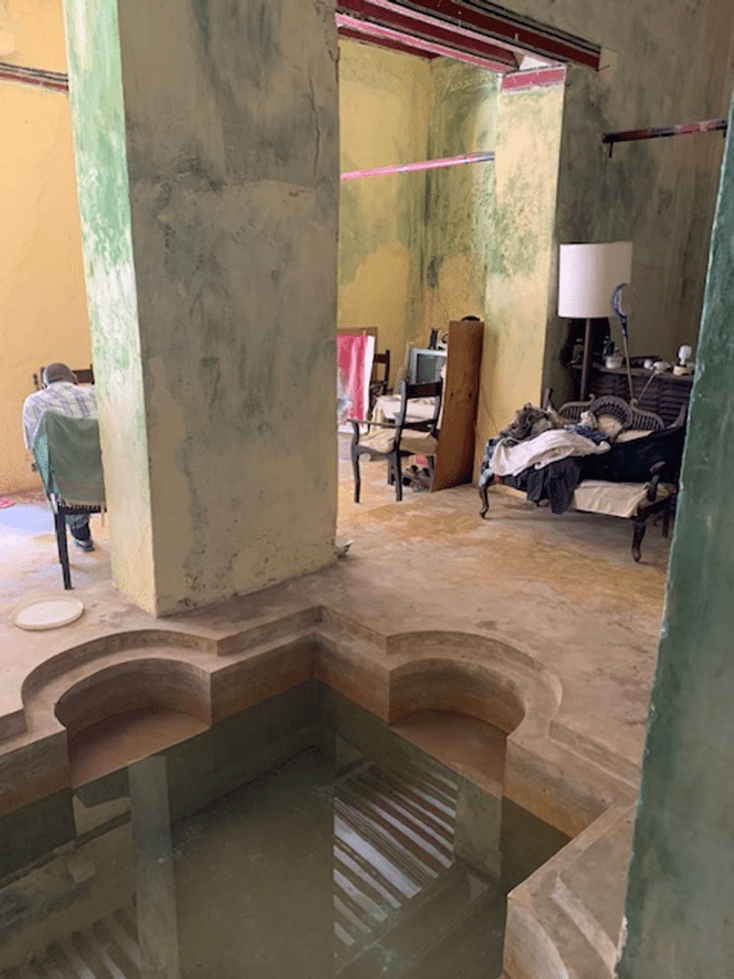
The kitchen was in ruins and on the top – 4th – floor, being hot. But because of the traditional thatched roofs they had had a fire and needed to replace the roof with rolled sheet metal. One more fascinating detail struck my fancy, the traditional ‘shelves’:

It was also very cool to see that their private well had openings on each floor – all the way up. Though I didn’t take a picture of that. If you don’t have your private well, then you have to go somewhere and buy water in plastic buckets in Lamu. This estate (apartment building) was also for sale for $250,000 but may have a Black American buyer lined up. It needs at least half a million in repairs but is still amazingly charming.
Prayer time came and our guide (named Ali) dropped us at Subira House (an extremely posh hotel) for a drink, while he went for prayer. There was a sign on the door saying they were looking for a new owner and I asked our waiter (a young man from Andrew’s upcountry neighborhood, so Luo, Obama’s tribe) to show me around. The building was the Zanzibar governor’s old home (though the governor himself was ethnically Omani) before they had to leave for the British in the mid 19th century. It is gorgeous: three courtyards, one for each of his three wives of course; thirteen gorgeous rooms and many public lounge spaces. Like Wow !!!! My pictures didn’t do it justice but here is a website: https://www.subirahouse.com/
I really ‘feel’ that place and want to move there! Perhaps I should be the Omani Governor of Lamu (I have always been ambitious after all). This ‘compound’ is in the heart of the old town, so outside is dirty and crowded, andthe hotel is tucked right up behind the old fort which the British made into a prison, as it stayed until 1984. The houses tucked into the tiny claustrophobic roads of Lamu are often spacious and gracious, with their rooftop gardens and frangipani trees, personal wells and servants’ quarters. It again occurred to me, that with women observing purdah – home is the lovely place to be, and the streets are for donkeys and businessmen. Not Gracious.

But at least there is no room for cars in Lamu, they use donkeys and bicycles all over the island. But sadly motorcycles are making headway.
An interesting feature we also noticed was that there is a thick wall with an alcove holding two benches beside every front door in town: they are much cooler than the narrow dirty roads because they are tucked into the thick corral stone walls in the shade. When you go visit your friend, you are not allowed into his home because he presumably has daughters, so you wait at the front door and y’all sit and chat together, he doesn’t invite you in.
This detail goes hand in hand with another thing I notice at the Subira House where we stopped for ice cold juices while Ali went next door to the mosque next door to pray. A woman (employee) was walking around in a very light cotton colorful house dress that I wouldn’t feel decent in because it looked like a night gown. But when I saw her I thought ‘ah yes this is the African nude zeitgeist, more power to her, she can still be comfortable in this heat’. Then she had to run out for an errand….probably to go pray across town at the woman’s mosque, and she put on one of those horrible black burkas and a black scarf to head into the hot streets.
80 percent of Lamu is Muslim and 20 percent is Catholic, and its Ramadan. I talked to he Luya man who showed me around Subira house about how I would refuse to wear black in that heat. I said I would cover up in white cotton if needed but not black silk and he said “yes its like the men are punishing them for being women. They didn’t do it on purpose”. I thought that was insightful and I often think that men want to punish women for our power over them, but that is a different article.

There’s the poor woman who made us talk about burkas.
Hotel rooms at the Subira house cost about 100 dollars a night, and there are 13 of them…..the present owners are asking for 200 million Kenyan shillings, which is somewhat less than 2 million dollars. It is a well-functioning business of course. I immediately fanaticized about my dream of a ten-person commune. We could each pay 1,500 dollars a month for the next 25 years. This would obviously be complicated; but it is theoretically possible. And a girl can dream right?
Anyway, After breaking open my heart into retirement home fantasies, we continued onto to the main square in town. It has a big old fig tree in the middle in front of the fort that we didn’t go into and the square was named for meeting ‘under the tree’….(just like Paris used have a big old oak tree for law officiating in front of l’hotel de ville).
At one point we were walking near the Madaraka (Muslim school) at closing time and a burka clad woman was walking her son and daughter home, little girl all enrobed as well, when they stopped to look at me (fully white people are rare) I said hello and they took my hands to kiss them out of respect. I had heard that old Swahili was very respectful of older people but that one blew me away. They were so terribly sweet and gentle that I almost cried.
We stopped by a silversmith who saw my white skin and smelled blood, his stuff was pretty though and he let me look for free. He even showed me how he buys silver in powder form to make his earrings and statues. He runs the store front just like his grandfather did before him.
You gotta love a place that is so old school and traditional, while being quite laissez-faire about the tourists and new residents. Just chill and comfortable with what it is.
Obviously, I did love Lamu though it is very hot indeed.
 The View from a Broad
I so enjoy your posts, Lili. I almost feel like I am there with you!
LikeLike
Thank you for sharing your adventures!
See you soon
LikeLike