Belonging


As a traveler my whole life, leaving places and – much more painfully –
people I have loved (and still do) all down the trail, I was both excited and
challenged to talk today about belonging with you, my friends, my
community, my new tribe of Anglophones here in Paris.
I suspect most of us, certainly I, started as a kid by belonging to my family
first and foremost. Though painful, my parents’ divorce when I was 8
years old caused me to double down on the insignificance of those who
were not relatives. I didn’t belong to anyone who wasn’t my
grandmother, a parent or a sibling, I had no cousins so that made us a
tight little group. Not safe, but tight.
Perhaps then its normal adolescent behavior to look further afield for
ones belonging – but as a 3rd Culture Kid (more about that term later) I
didn’t venture out halfway. I flipped from my birth family to my made
family both rather young and rather abruptly. Like many women
throughout history, I gave up my mother to be like a daughter to my inlaws.
Ironically, it had been my mother who had advised our friends in my
presence “you can’t choose your family, but you can choose your
friends”.
I wanted more than anything to belong – I was willing to do anything…..to
be anyone you wanted me to be …..so that I might truly belong.
Fast forward 25 years and It became pretty clear to me that the only way
to truly belong was to be absolutely yourself and gravitate to those
people who can accept you as you are. Moving around a lot like this is
hard, but I tried so very hard that I mostly thrived. But I got really tired.
Another ten years and three homes later and my made family is now as
strewn around the world as much as my siblings. My nomadic lifestyle
topped with a serving of the western myth of rugged individualism has
left me geographically and linguistically standing aside from “Normal Life”
(whatever that is ).
But I am stronger now, and ‘grâce a’ ZOOM and What’sApp, I am in good
touch with “my people” on three continents!
Honestly, confinement has been good for me because I took this time to
lick my wounds in a safe haven, enough to get over most of my rage
against the patriarchal machine. God only knows how we will move
forward and she isn’t telling anyone.
So here we are, summer of 2021, I turned 60 and found myself mostly
retired. But I’m healthy and financially solvent – so I am actually doubly
blessed: having both some time and some money.
My daughter and I decided to try the Chemin de St. Jacques but this time
just for a week through Brittany. Five days and several touches of grace
into our path we found ourselves in the town of Châteaulin for the
Assumption of Mary. Exhausted and maybe even a bit stinky, we
scrambled up the hill to the town’s Notre Dame church for high mass in
the virgin’s honor.
Here I might mention that my dad was Irish Catholic and my mom,
against her husband’s will, raised his daughters to be good midwestern
Catholic girls (with all the baggage that carries). She herself never bought
into the guilt-inspired patriarchy that goes with this culture (neither did
my half- sisters) but I did for way too long. I have also always loved the
cult of Mary…..”Hail Mary full of Grace. The lord is with thee, blessed art
thou amongst women”….etc etc. [I love the fact that we tutoyer her].
Meanwhile my 30 year old daughter is into the divine feminine, and GAIA
mother Earth. …. When we got to Notre Dame de Châteaulin we were
late and the door was shut. We tried to open it but it was big, heavy and
seemed locked. We walked around to the front of the historic cathedral
but couldn’t figure out how to open that ancient door and get in either.
So we sat down on the entrance steps to just listen. It was shady and cool
here but obviously we didn’t really feel the sense of belonging. We
listened quietly for about 20 minutes, following the mass in French and
through the thick stone walls that had kept the cult of Mary safe for
about 500 years. Then the organ and all the practicing Catholics in
Châteaulin began to sing ‘my song.’
Any of you who know me know that I love the old black spiritual
“Amazing Grace”….Though this may have been the first time I heard a
pipe organ play it.
Sadie and I sang at the top our lungs in English because we finally
understood, that each of us belongs wherever we feel we belong here
and NOW.
Let’s come back to the search for belonging. I always knew that I wanted
more than anything else to be part of a good team. And yet at another
level it is quite clear to me that we, each of us, and therefore me too,
must work out how to be part of our world without losing our true selves
in the process. So I came to Paris alone a few years ago to try (again) to
belong here and now.
As the legendary Maya Angelou said:
“you are only free when you realize that you belong no place.
You belong every place – and no place at all.
The Price is High but the Reward is Great”
This quote scares me. It is quite a different take on the idea of freedom
that I am not sure I’m ready to fully embrace. But I fear that Dr. Angelou
speaks the truth.
The need to belong and the struggle for belonging probably resonates
particularly deeply with us Anglophones in Paris, gathered here partly
because we are a community made up largely of immigrants. In some
respects, we here are all strangers in a strange land.
But in a very real way, so is every human being on earth. Each of us is
constantly migrating and changing throughout our lives. Through each
change we have to learn to renavigate our own sense of SELF-belonging.
As a new baby we are each born into our family (hopefully) and we know
we belong there. It’s a matter of survival for infants to belong fully. But
soon we start to second-guess ourselves. As a toddler we see that we
don’t feel pain in our own hand when mommy burns her hand. Where do
I end, and others begin? As a child we struggle to tell our guardians what
we want and need. Do my parents really understand me? Who do that
want me to be? Am I that person really? Change is good, but we must
change ourselves constantly to keep up with it.
So then as adolescents lots of us venture out from our families because
often we feel the need to ‘go it alone’. Perhaps it’s normal to look further
afield for our belonging – young people put a lot of stock in their friends,
“their tribe,” to belong to. An aside here is that social science points out
that Third Culture Kids (those of us who grew up in a different culture
than our parents came from but then returned to the parent culture, we
TCKs are not immigrants, if this is a new concept to you, ask me about it
later). Anyway, we are slower to leave our families because we don’t fully
fit into the culture of any of our host countries. The break with family is
often later and perhaps more violent for we who were ‘raised abroad’.
Then many of us marry as young adults because it turns out that ‘going it
alone’ is kind of lonely. Here is how and where belonging faces that
weird “happily ever after” paradigm.
While I was discussing the concept of belonging with several friends
during this summer the question of monogamy always came up. I blame
Hollywood. And I don’t buy into the myth of you “belonging exclusively to
each other” as the ultimate fairy tale ending either. We could probably
talk all day about, Adam and Eve, bonobos vs. humans, and our
prehistoric sexuality. But there I would be going off on a tangent. So let
me just say unequivocally that to me Belonging is much bigger than
romantic belonging.
As Rumi said:
My place is the placeless,
A trace of the traceless,
Neither Body Nor Soul,
I belong to the Beloved
I Belong to No Religion
My Religion is Love.
Every Heart is my Temple.


Belonging is a fundamental human need. We, in the west, used to
pretend otherwise. We used to admire the ‘lone wolf,’ the rugged
individualist. The Norwegian bachelor farmer. But a shining silver lining to
this covid pandemic has been just how clearly we have all seen the need
to belong during these trying times. Without belonging we are somehow
less than human.
So we will make up something to belong to. We will make sure we belong
somehow. Some have become Homo Economicus and belong to
capitalism and the Goddess of greed. Some belong to their hatred and
fear, their sickness and need. But we ALL belong to something,
someplace, someone. Or we would not get up in the morning.
The researcher Brene Brown defines Spirituality as, “recognizing and
celebrating that we are all inextricably connected to each other by a
power greater than all of us and that our connection to that power and
to one another is grounded in love and compassion.” This is a Sunday
service at a church, so let’s not be afraid to talk a bit about spirituality.
It seems to me that it is our life’s work to learn how to belong to
ourselves and our world, in the here and now. Thanks to your kind nonjudgement, I’m starting to feel like I belong here, now with y’all.
If Brene had asked me personally what belonging meant to me, I would
have to say “it means being part of the team”. Having moved my whole
life I learned early to work really hard to develop the team that I want to
be part of. So one of the things I love about being here in Paris is that
nobody belongs her any more than I do. I can be here, define myself as
Parisian, with my crappy French and all.
When I was a kid, a mantra around my family was always “at least I’m
useful” – so I have always struggled with the need to be useful in order to
be part of a club. Can we belong without helping? Dr. Brown says “true
belonging is not passive, it doesn’t come from just joining a group…….”.
So how DO we belong?
She went on to discuss just how divided the USA had become (her book
“Braving the Wilderness” was written in 2017). Dr. Brown talked about
how we were dividing ourselves into camps of mutual bad mouthing on
social media. These have the psychological effect of making us feel like
part of the in-crowd as opposed to the out-crowd. And yet, we are getting
lonelier in the process. Dr. Brown wrote “we have sorted ourselves into
like-minded groups in which we silence dissent, grow more extreme and
consume only facts that support our beliefs” The once United States of
America may no longer be a healthy place to find your belonging these
days.
Dr Brown continued her discussion of facing that terrible wilderness of
not belonging by stating that “True Belonging is a practice that requires
us to be vulnerable, to get uncomfortable, and to be present with people
without sacrificing who we are.”
This is easier said than done!
Meanwhile the world is full of social media with its blogs, fake news, and
conspiracy theories (as well as the conspiracies that engender them). This
media has been rendered much less communal (or social) since Facebook
started. Our public ‘conversations’ cannot encourage trust! But here is
another tangent I’m not going off on…..
So we must find our belonging elsewhere. But the good news is that we
can, we all have different ways of doing that: yoga class? Friday happy
hour; family, or quiz night? Or even maybe attending a service at your
favorite UU church sometimes. Also, I get a lot of comfort out of my local
shopkeepers and merchants in my neighborhood in Paris. They let me
belong here, despite my horrible accent.
True Belonging is the spiritual practice of believing in and belonging to
yourself so deeply that you can share your most authentic self with the
world, the general public. You can find sacredness in both being a part of
something and in standing alone in the wilderness. True belonging
doesn’t require you to change who you are. It requires you to Be who you
are.
I am still figuring out who I am, after a lifetime of being who my people
wanted me to be, so of course I am still working on belonging here with
you in Paris, or in Nairobi, Kenya, with our school or in six different cities
in the new world with my siblings. As a Japanese friend from the
International School of Paris said to me years ago “Home is where my kids
are”. This was just when her kids were starting to graduate and move out
to college and beyond. She now lives in Houston, and we are still Linkedin friends.

Do we belong to each other?
One of the many joys of being a Third Culture Kid is that you can visit
almost anywhere on earth and see old friends, but the downside is that
‘your tribe’ is strewn around the planet. As an American who was born in
England but grew up largely in Africa, I just thank God for Facebook and
Instagram. There is of course a Facebook TCK community for those who
want to join and belong. Angelou said that true freedom comes from
belonging everywhere and nowhere, perhaps we wonderers have a short
cut to this freedom.
But “True belonging and self-worth are not goods, we don’t negotiate
their value with the world,” Brene Brown said: “the truth about who we
are lives in our hearts. Our call to courage is to protect our wild hearts
against constant evaluation, especially our own judgements. No one
belongs here more than you.”
On that note I will welcome your authentic selves here this morning with
a simple question to you: What, where, and to whom do you belong, and
Do you belong to yourself?

What if

What’s with this meaning of life stuff?

What does cosmic meaning even mean?

Why am I here?

“to do God’s will” What the hell is that?

“to love my fellow man” What is he here for then?

“to make the world a better place” Well that’s a low bar.

What if…life just is.

What if …each day is what it’s about.

not necessarily earning a living, or

living up to your expectations, or

even living life to the fullest.

But just being alive.

What if life is nothing more than the sum of its parts:

the breeze on your face as you walk to work,

the growl in your stomach when lunch is late,

waking up to the sound of a car alarm in the middle of the night and thinking it is the cicada bugs,

or stopping to catch your breath as you miss the bus,

Plus the smell of your grandmother’s perfume, or the warmth and weight of your blankets on a frosty morning.

Could we really ask for anything else?

Joan’s Funeral

My mother-in-law lived with us for 5 years full-time and for 15 years before that half-time, from the time her husband died. She was an alcoholic from the moment I met her (when she was just about to be sixty) – which by the way was how old I was when my own crazy mother died. Obviously I have a mother karma thing….but more about that in another story.

Joan was a pretty and bright lady – born in Newfoundland but educated in Nova Scotia. She wanted nothing more than to be correct in society’s standing. She loved her husband very much and was willing to stay in the little box society made for her. She had been trained as a concert pianist, but before having children her husband had told her to quit taking lessons at the Peabody (because he was worried that her professor was hitting on her). Instead she took to drinking too much, I imagine. It was very much the done thing in her social circles.

They had trouble having a baby and by the time Lew came along he was the apple of both parents’ eyes.  I think Lew’s dad was actually a bit jealous of Lew though, by the time I met him. Perhaps about his son’s physical strength and youth (ha and maybe even about his gorgeous wife for all I know). Lew’s dad had bad rheumatoid arthritis all his life, he had been a mathematician and had made good money with IBM – even helping on the team that wrote the early computer language of Fortran. But Joan became an alcoholic over those years.

Fast forward to Christmas 2010 and daughter Sadie’s husband is visiting us from University – Mom, Dad and Grandma living in Paris. Sadie and Son Terry are there too of course. He is trying to heal from his first bout of schizophrenia, taking a year off school, and Grandma Joan is smoking in her back bedroom – and sending Terry out to buy wine even though his medicine is strictly counter indicated for alcohol.

We five younger people went to Strasbourg (leaving Joan with her visiting nephew John, because she could never be left alone for even one night. She would drink herself under the table, literally, and break an arm). We drove through the last really snowy day I have every seen in Paris for our Christmas holiday and son-in-law Jacob even encouraged us to stop by my old family homestead (that my great grandfather had vacated when his town became German). Back home again, Grandma Joan played the piano from her wheelchair while the rest of us sang along our favorite christmas carols. I took this as a perfect example of families taking care of each other. It was pretty good. But it turned out that Jacob could not go with daughter Sadie to England as they had planned.

We thought of a plan for Sadie and Jacob to go rent an apartment in Kenya and Grandma Joan could go back later and live with them, next year – after Sadie finished her music technology degree. They would  go there together and the three of them could take on the Kenyan music industry by storm. Or at least Grandma could pay the rent and the young newly weds could build a studio and hip-hop brand.

Terry would finish his degree too. He went back to St. Andrew’s and somehow got through (that is another story for another time that Grandma Joan didn’t take part in). Lew and I would stay in Paris.

But within that next year things fell apart. By this time Joan had nurses come bathe her every other day in our Haussmannien apartment, but they only spoke French so I supervised. Lew had a work trip to Turkey in March. I went with him just for a holiday. We were having a good time in Bodrum, until Grandma got too sick – being left alone with only Terry panicked her I presume – and she got pneumonia.

We rushed home and called emergency services who took her to the hospital. The French medical services said that she couldn’t go back home with us and that she needed more care than I could give her. I did have a job too at the time, I was adjunct faculty at a business school in Paris. Joan was fine with the nice first place we took her too for the first month after hospital, because she thought it was temporary. But after a month and 5000 euros cost, we decided that she needed to go to a cheaper place to stay permanently.

The second nursing home wasn’t as nice though it looked fine to us despite the shortage of English-speaking staff. It was in a less posh suburb and our fatal flaw was that Lew was out of town when Terry and I took Grandma across town in an ambulance/moving truck to her new home. She had always deeply trusted Lew and his father before him. But perhaps she only really trusted him, I’m afraid. So Terry and me taking her to her cheaper place wasn’t good enough. She hated this new place. And they put her in diapers at night too. We visited her often, pretty much every day, but she was really unhappy and becoming bitter. She wasn’t allowed to smoke and was only allowed wine with lunch (where she sat with some other English speakers).

So, we decided to ‘spring her’ from this particular prison. We flew her to Kenya to live with Jacob until Sadie was done with her degree and they could happily live every after. The 9-hour flight nearly killed her of course, but she loved the Kenyan staff and the balcony with a view over nature. She smoked, drank, and socialized in English to her heart’s content.

But she only lasted a few months there after all. Lew had told the really good hospital who could take care of her perfectly, that she didn’t want any more blood donations….she had some kind of an anemia that we could not heal – we could just mask it with blood transfusions. After a few months we all decided not to mask it anymore. In Kenya particularly, regular blood transfusions felt too vampire like.

Lew and I were together on another business trip in Barcelona when he got a call from Kenya and had to hold firm with the hospital that he only wanted hospice care for his mother. It must have been very hard on him, I remember him having to shout at staff in Nairobi.

He flew immediately to Nairobi though and went straight to the hospital.

I guess he went to see her and was told that she was in a “light coma”. So he sat with her. He held her hand and talked to her…she clearly knew he was there, she squeezed his hand a few times. Then he said good night and headed home to sleep. But he was called back before he even got the taxi heading in the right direction. He turned right around and got to her room in time to see her corpse still in its death throws. The nurses kicked him out of the room for a few minutes then he was allowed back in to see her all cleaned up and peaceful.

We all trusted and knew that she had moved to a better place. Her time had come (such is life: none of us are getting out of here alive) and it was good that the hospital didn’t keep her on life support, and in limbo, forever. We are born alone and we die alone.

Then poor Lew had to take care of funeral arrangements.

Luckily his parents had paid some American trust to cover the costs of cremation in advance. Unluckily Kenyans don’t like cremation.

The next day Lew had to go into Nairobi Morgue and file death certificates and such. He also had to buy a coffin because the funeral parlor would not do business with him without a coffin.

Jacob was there insisting that Grandma be cremated according to the Hindu faith (in which he was educated). According to Hindus, of whom there are plenty in Nairobi, the spirit leaves the body in the smoke and the warmth of the funeral pyre. But according to the funeral parlor they were working with, the body is sent into the hot ovens in its coffin to be burnt like that. Jacob would have none of it. He wanted to sit near the fire as she burnt and feel the warm of her spirit as she moved on. So the parlor took her out of her coffin and sent her into the brief hot flames. Jacob was very disappointed that her small body hardly made any smoke come out of the chimney. But there were some grievers to bear witness all the same. Lew was then left with a coffin that he didn’t need – he donated it to a family of mourners who were there at the time and who couldn’t afford to pay for one (We were saving a tree I guess).

Next the funeral parlor was going to just throw out her ashes, but Lew demanded that they be saved in an urn, and given to him. His parents had wanted to be together in their urns and we had his father’s ashes on our bookshelf (a fitting place for an avid reader). The funeral parlor had no urns to choose from – but Lew demanded something – so they brought something. In a bizarrely humorous twist of fate, the ‘urn’ they could provide was a Japanese lunch basket, made of light plastic. Lew had mentioned some loving quote so this one had two tiny penguins on it saying ‘love forever’. It certainly didn’t match Lew’s father’s urn which was heavy and black and made to look like an ancient Grecian vase. But it did travel easily back to France with him where we had another memorial service for our grandma Joan.

None of our kids could join us – but we will always remember our last Christmas together to remember Musical fun-loving grandma by. “We will always have Paris”

I also remember that Lew told me by phone right after his mother died in Kenya. I called my oldest sister at her home in Seattle, to tell her the news. While I was on the phone to Anamaria (international calls were still expensive at that time) I heard a terrible crash from my bedroom. I hung up to go see what it was all about and found that Grandma Joan’s mirror had jumped off the wall. To be scientifically fare here – this apartment was above several very active train lines along Blvd. Magenta, and we always felt small earthquakes going on. Still the timing was eerie and when I called Anamaria back, I said that if anything else jumped off the wall I was checking into a hotel that night. But nothing did and I cleaned up the broken glass the next morning.

The last phase of this story involves the dispersal of Grandma’s ashes, along with those of her husband. We decided that one of their favorite places on earth was on Cape Breton Island Nova Scotia where they had honeymooned so many years before, and we would spread there ashes there. So we just packed their urns in our suitcases. We flew to Boston where we met Terry and then drove to Nova Scotia. Had we known that this is considered highly illegal we may have thought twice about it – but we did not. Joan’s third ceremony was held on the beach near her nephew’s home with a handful of mourners present. Her son and her grandson each poured out one urn just at sunset and we toasted her life.

Birthday Break-in

Last week, I was off enjoying a lovely afternoon birthday party in honor of me in a friend’s courtyard clear across town when I got a couple of unexpected phone calls from a French cousin who I haven’t spoken to in years. I thought she was wishing me a happy birthday and I ignored them. Then I got a call from an unknown number. I chose (after plenty of kir royals) to ignore this call too. Finally I got a call from my older sister from the States (via What’s App). Since we had already spoken for my birthday I got a bit nervous and answered her call. She shouted “your apartment has been broken into and they left the door wide open. Get home now” – so instead of taking the metro home I decided to call a cab. But the bolt driver cancelled on me after going to the wrong address. Then my adult son and I flagged a taxi on the street. Therein was the only actual theft I have found so far. Twenty two euros was more than I could really afford – but I was grateful for the ride anyway.
On the way home and while waiting for the Bolt I called the unknown number I had refused earlier, and it was the police flipping out at me. He said he had found my apartment door wide open and had shut it. This is on the 4th floor of a secure apartment building in a good neighborhood in Paris by the way.


The policeman also asked if the ipad or MacBook pro he was holding were mine or if I had lost a gold necklace with an M on it or some fancy Dior perfume. They thought they had found the burglars but weren’t sure what they had stolen. I had to deny ownership of any of that cool stuff and when I got home my key was still hidden in the hallway and I used it to get into my flat. It was a mess. Just how we had left it. I first thought of my computer because it is the only vaguely valuable thing I own, but there it was plugged in on the desk right in front of the door. I then worried about the other computers that we were shipping to Kenya and I thought I didn’t see them….but I found them right where I had left them, vaguely put away.
Laundry was drying beds were unmade and Nothing was taken.

So I called my sister back and told her. She laughed hard as she explained to her date that “they had broken into my sister’s apartment but didn’t want anything”.
After repeating my mantra that the best way to not be robbed is to not own nice stuff I called the police back and neglected to ask how they had gotten to the 4th floor of my apartment building anyway. But I told them that none of that stuff was mine. The nice policeman told me that if I found anything missing I was to call his personal number. Then I realized that this was the police from several districts over in Paris who had left me a personal note inside my messy apartment. So weird.

We considered telling my insurance company that the burglars had come and taken our macbook pro and ipad and left us some shitty laptops but we decided against that.

Upon slightly sober reflexion we figured out that my son may not have shut the apartment door properly when he left. The police had been hunting down these three suspicious (read African maybe) men and had a fascist conniption involving calling my cousin to break up my birthday party (she may be on file as my french next of kin?). Son summed it all up well with “some black guy went shopping and the police had to find out who they had robbed from”.

Punch line conspicuous consumption will get you in trouble and the French Police have your number.

Time and Atrocities

Forty years ago (at 21 years old) I came to Paris with my 17- year-old sister for our junior year abroad/gap year. We met two 19-year-old Canadian girls en route and became fast friends. We four travelled together, partied together, and learned together. Us “Paris gals” have remained good friends throughout the years while we bounced our lives off of each other ever since.

Forty years doesn’t seem very long to me ….sure we ‘Paris Gals’ have raised kids, fallen in and out of love and changed homes and husbands over the years. But we are still the same as we ever were really. Essentially nothing about us has changed in that time. This weekend, we had a zoom reunion and picked up our conversation as if nothing had ever stopped it.

Forty years before that date (when we awesome modern world travellers met in ’82) back in July of 1942 the French Police (not the German Nazis, but the French police mind you, under Petain) rounded up Paris’ Jewish citizens (even though nobody had even told them to do so, despite my previously understanding the German’s had not demanded this deportation). These people were collected over the night between July 16th and 17th and taken to the Velodrome d’Hiver (which was just outside Paris city limits) to be processed and shipped off to Auschwitz as part of the French deportation effort. Other Parisians were told at the time that these families were foreigners – but many of the fathers had actually fought for France in WWI. On that fateful night the men were already gone though, and it was the women and children who were shipped off to death camps.

There is now a memorial garden for the more than 4000 kids who were taken from their Parisian beds during the night, counted, processed and shipped off to die. This weekend I also observed their descendants grieve for their grand-aunts and uncles. It occurred to me that those deported children would have been the same age as my parents, and I grieved for the evil that destroyed them all.

It wasn’t until the presidency of Jacques Chirac (I always liked to call him ‘Black Jack Shellac’- after bug’s bunny’s French gambling character) that France finally accepted this country’s complicity in Hitler’s final solution. So that would have been maybe about thirty years ago?

Twenty years ago my youngest sister visited while doing a paying gig for her college professor about the Jews in Paris during the “occupation” – strangely named actually when you consider that Petain welcomed the Nazi bullies with relatively open arms rather than risk any more blood bath. Hahahahaha.  Of course a huge exodus of Parisians followed the Paris occupation (and the Germans did bomb those people as they were walking away) of anybody who could get out of town, and as far south as possible – Jews included. The Parisians weren’t happy to see the Germans. But many people were stuck here anyway.

My sister’s visit was before the book called Le Suite Française was published (found in the private trunk of a “final solutioned” author by her daughter). But I had seen a smattering of signs around the Marais, particularly in the Jewish neighborhood along rue de Rosier (the road of rosebushes). Back in the ‘90s there were still Jewish bath houses, delis with awesome Russian pickles and yarmulkas for sale in little shops off the rue de Rosiers. To this day there is a working trade school, mostly for Jews but not exclusively – as established by Rothchild a long long time ago in that now highly sanitized neighborhood. The Marais is now the world’s largest open-air ‘please touch museum’ but the Ashkenazi Jewish neighborhood has been replaced by a self-conscious Sephardic Jewish quartier. There is also a memorial to concentration camp deaths on the tip of the Ile de la Cite which is quite moving, though that historic spot would date back to the time of Julius Cesar if you think about it.

Anyway twenty years ago, my kid sister and I made a concerted effort to learn about this infamous “vel d’hiv” where the ‘raffle’ (or round up) took place. The Velodrome d’hiver, as the name implies had been for bike races in the winter, but it served the anti-semites as a convenient holding place for the 13,000 Parisians who were collected in the dead of night so that their neighbors could maintain deniability. Since it had been just outside the city limits at the time, my sister and I thought it was further away from the Eiffel Tower than it has proven to be. I recently learned that during WWII Algerian (and there were lots of Jews from Algeria) could have gone to the Grande Mosque of Paris and been declared Moslem and therefore exempt from this deportation…..So I think antisemitic is a misnomer, Ashkenazi jews are not Semitic but Muslims are if you ask me (but of course nobody has)

Then, 15 years ago, I bought a flat across the street from where, unbeknownst to me, the “Vel D’hiv” had been. It turns out that the boulevard Grenelle, above which runs metro line six (and it was running at that time too) was the boundary of Paris right on through WWII. What may now be the most touristy metro stop in Paris (named Bir Hakeim instead of Eiffel tower as a nod to a small battle in North Africa during WWII and as a good way to confuse tourists) was on the very edge of town. Metro Line 6 is largely above ground and was built where one of the city’s protective walls had once been placed, and where executions took place during the ‘belle epoque’

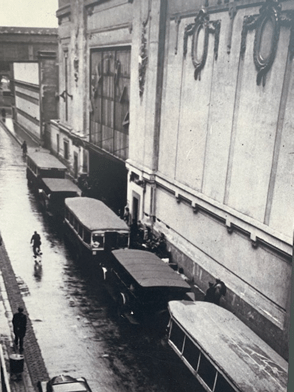
Here is the picture that somebody found of the night of the round-up. It was practically taken from my apartment window (this apartment was supposedly built for the builders of the Eiffel tower – so it was certainly here in 1942)

 I’ve often wondered what the tenants at that time thought as they looked out the window.  I believe in locational Karma and I think I should burn some sage.

Years of construction across the street from our newly purchased apartment in this new millennium saw the destruction of the Ministry of the Interior and the building of the headquarters for Le Parisian newspaper business. They also built a pretty little “Jarden des Enfants” with a wall that includes all the names of the children who were sent to their death from right here 80 years ago this weekend. I love the four teenaged boys names that say escaped next to them.

Fifty years ago – I remember travelling through London on my way to Africa in the 1970s and all the adults, “old people” to 11 year old me, explained how “this spot was bombed, that spot was where we hid” etc. But the whole story felt like ancient history because it was before I was born. Then when I got to Paris in ’82 it looked so untouched by the war that I could effectively avoid thinking about that nasty history for the most part. I saw the plaques though, and there was a plaque near the Latin quarter, and on the same street on which Descartes died, which amounts to a piece of poetry written by a Jewish poet and put outside the home he was pulled from on July 16th 1942 that still makes me cry when I show it to friends.

This weekend, protected by the same police force that rounded their great aunts and uncles up 80 years ago, the children and grandchildren of the Jewish deported showed up for a religious memorial. Our new prime minister – Elizabeth Borne – is the daughter of a deportee. I understand her dad committed suicide after he got back home. Simon Weil’s son was there yesterday as well.

Here is a picture of saturday evening’s Jewish mourning service.                                            

It disturbs me because it looks too much like the old picture. I vowed that if they started putting people in those unmarked vans and taking them away I would film the whole thing as a testimonial. Luckily they didn’t.

So I have been a bit sick all weekend,  I’m trying to work through my thoughts about time and atrocities. The first time I saw a memorial celebration for the children of the Vel d’hiv I brought down some California almonds to share and improve the karma as best I could.  I’m trying to share my thoughts here as a way to off-load them and to unburden myself.

Time is short, History is long and I am tired. But its important that we not raise our children nihilistically.

The civilization that is the EU today has come at a terrible price and I wish the US and Israel could achieve this same civilization. But it seems that revenge and greed are in the way – “ask not what the world owes you but what you owe the world”…this too shall pass.

Earth and ReBirth

Easter for me has always been a celebration of rebirth.

Winter in Buffalo NY – where I spent many formative years – was bleak gloomy even a bit scary with the potentially deadly snow falls.

So, to get through it we had to have complete faith (yes faith) that winter would not last forever – as a kid that was easy for me. “Spring and the Easter bunny would bring back our green grass and barefoot weather”

Obviously, I had never had any first-hand experience of the death on the cross and the resurrection of Christ, so there was nothing gory about easter for me. In my mind the resurrection came from the leaves of our trees. Clearly the Japanese Maple in the front yard and the oak in the back yard were coming back to life. In Buffalo March was a month of slush and melting dog poop in my neighbourhood.

April brought the yellow exuberance of the forsythia and the courageous purple crocuses popping up through the snow. But we often wore our snow boots to Easter mass, so the Easter bonnet was not a thing for me.

Easter has always been tied to the inherent coming back to life that is springtime. Then came Earthday: April 22, 1970, was the first one. I was 8 years old at the time, so it impressed me greatly. My age group really loved to tell our parents to quit being litter bugs, but then we went on to drive our SUVs around looking for the best Barbeque Steaks – as served on a teak table thank you very much.

It seems to me that the human consciousness MUST keep evolving if we are to survive this latest mass extinction going on all around us right now.

But GAIA Mother Earth will be fine. She is used to cycles. We can all die she doesn’t care.

You know how puppies bite the hands that feed them? So the mama dog has to wean them, by nipping at them or running away? If humans take pet dogs, we have to train them as well.

Could Gaia earth b trying to train our poor little baby mammalian brains? Our, monkey brains bite, and we have to grow out of them Personally I have faith that Gaia will get us trained before mankind is extinct. …but ots only faith.

Science has brought us a long way, but with little concern for the limits of growth that we have known about for sometime now. Pythagoras taught us geometry, Galileo brought us astronomy, then the Einsteins figured out that energy equals the total mass multiplied by the speed of light. Wow! So what did we do? Bomb each other.

Science has brought us far. But in a very masculine, tower building kind or way….Sir Isaac Newton famously said “I can see so far because I am standing on the shoulders of giants”. That’s great. But this has lead to want to go to Mars without even cleaning up our own soiled nest?  How macho is that? The old bible told us to husband our earth – but then to go forth and multiply. I think it is now time to get more humble, with our host planet and sole resource provider. Remember that if you are nursing your baby but the police are knocking at the door – your milk will dry up. We need our mother to continue to nurture us – not to send us to Mars (without air or water)

Mother Earth is all about rhythms and networks AND CYCLES – not squares, angles and towers. The UUs STRESS that we are each an integral part of the network of life. We are NOT as strong as today’s strong men/war lords…Gaia is not able to support those capitalist industrialist billionaires. She (we) are only as strong as our poorest children, our sick refugees fleeing Syria, Palestine or the Ukraine, our self-beaching whales.

So, I say welcome to the Age of Aquarius – we are well into its dawning now. I hope that Aquarius will prove to be a much more feminine era then was linear, jealous Pisces. These cosmic cycles are supposed to last millennia. All our great spiritual leaders – from Confucius and Buddha through Moses and Jesus to Mohamed – all lived in the era of Pisces. Lately we have had Thich Nhât Hanh and Greta Thunberg step up to the plate.


I’m pretty sure Gaia earth knows all this. Now our human society just needs to figure out where we stand on this planet.

If Humankind is to survive, we will have to pull upon more than just faith in the Father Son and Holy Ghost. We also Have to chip in with our fellow earthlings: the trees, the cockroaches, and the sharks and eagles to help mother earth.  Starting to help on Earth Day feels right to me. Hopefully we can join team earth as fully paid-up union members. We are neither above nor below the rest of life on earth we are just part of the great living Gaia earth. And if we have more power, so we have more responsibility…remember Noblesse oblige (as the french say).

In fact, I understand that Mankind’s survival is predicated on our faith in ourselves and earth to keep nourishing us. We MUST share more equitably with each other and the rest of the web of life if we are to stay a part of it. Thanks, Greta, for pointing that out!

Of course, Easter is about Springtime. But I for one am in the autumn of my life. I am working on passing on the alchemists rendering of my life struggles and traumas to the next generations it the best ways I can.

When my daughter was two years old, she told me unequivocally that she had been my grandma before I was born. Of course, I don’t understand that – or anything else about the afterlife. But I DO have faith that the universe will work it out so that my Grandma’s winter wasn’t her end either.

As Mufasa from the Lion King explained in his talk to Simba “we become the grass and the antelope eats the grass” to love again.

I will close with a story that I believe is Taoist: There once was a wave who was loving life zooming across the top of the sea until it saw the coastline approaching.

Then it got scared and said to its neighbor – OMG we’re going to die. Look at that our end is approaching.

The neighbor responded – I don’t know about you – but I’m not going anywhere. I’m the whole ocean.

So to you I say in Zulu – “UBUNTU” which means – I am, because you are, because We are. God bless us everyone.

The Common Good

In my lifetime I have seen the demise of the concept of “the greater good” in the USA.  Maybe it was a myth when I was a little kid in the 1960’s, but at least it was a myth. Probably back then “Common Good” was limited to members of ‘your community’ which didn’t include women or ‘foreigners’ (like the Native Americans – who are actually the only non-foreigners in the USA). But the notorious WASP of “the greatest generation” probably did at least consider the greater good….I think. I remember “The Brady Bunch” and “The Partridge Family” on TV, if not “Leave it to Beaver” – dad was always right, but at least he was theoretically listening to his wife and children. Of course, everyone was white. It took Bill Cosby to break that barrier. By this time on the other hand, everybody on TV was rich – but at least they weren’t all white.

So the great American Middle Class was starting to feel micro-aggressions at just about the same time as Blacks were being allowed into it. But fundamentally I blame the loss of the concept of The Greater Good on the loss of the middle class at the hands of the greedy “globalists”. Reagan (who famously said, “what did my grandchildren ever do for me?” and even “don’t trees give off greenhouse gasses like carbon monoxide?”) was perhaps the beginning of the end of the golden age of America. My dad was a union man and an Economics professor…he was all about the greater good. He clearly saw the problems for women in our Economy, though he may not have fully grasped the troubles for African Americans. He died in Canada in 1976.

Somewhere during those years we started loving the capitalists “job creators” – Hahahahahaha. Sure for the Philippines maybe – and exploitative jobs at that. Then we decided that Health and Education should be for-profit ventures; prisons even; as opposed to being government responsibilities. ….It was all down hill from there.

Profit is NOT a human right. It is not even a human value. It is a form of theft from the capitalist over the working classes. If I sound Communist – so what, why don’t you?

Before a project is started, any project – be it public or private, local or global – it must be vetted to see that it is good for the greater good, not just for the good of the money behind it.

It is starting to feel to me like Gaia Mother Earth is being treated as if she were here for the good of the dollar bills that we have created not for the good of the earthlings who host us. That will lead to mass extinction – and I don’t mean the rebellion!

Maasai Warriors

Today the Maasai of northern Tanzania are asking for help online to save the lions of the Serengeti. This fact got me thinking. The Maasai are of course a famous nomadic ethnic group (‘tribe’) of East Africa who used to roam up and down the rift valley through what is today Tanzania and Kenya. They almost exclusively consumed cow blood and milk; and famously they had a rite of passage for boys to become men that required the killing of a lion without the use of a gun. The age mates (boys born in the same year) had to work together to outsmart the lion into some kind of fatal trap before they could be considered to be men. But this was back in the old days, as in my own age-mates probably had to do that. But not anymore, now the lions are too rare.

In Kenya, the Maasai are still notorious as warriors. An older Kenyan friend of mine once said “all Kenyans are scared of the Maasai, even of the women” Legend has it that they used to show up at the farming Bantu ‘tribes’ lands and say something like “Our cows will be eating your crops tomorrow. So, you can either leave to let us stay and fatten the animals, or you can fight us”. The other tribes often chose to leave because they decided not to risk war.  Nairobi proper was historically a fighting land between the Maasai and the Kikuyu for example. In fact, 100 years ago, the British wanted to name Kenya “Maasai Land” because of their respect for these no nonsense warriors, but the 51 other tribes that make up Kenya didn’t like that idea so much.

Well as it happens – Even the Maasai have now noticed that lions are endangered, and they don’t want them to disappear completely. Worthy adversaries are hard to find after all.

I am no expert on the Maasai but today’s email made me remember my first interactions with these famously proud nomads. It was during a pivotal time in my life – unequivocally, the best year of my schooling.  I thought I might share my story here.

When I was 15 years old my pregnant mother and her second husband with their two year old daughter took me and my 11-year-old sister to Dar-es-Salaam Tanzania for Oscar’s work as an economics professor. This was pretty exciting for us because we had lived a couple years in Ghana and aside from my tropical health issues we had loved West Africa. So East Africa was gonna be great: I studied up on the Serengeti, on the Maasai and the Kikuyu, the Great Rift Valley and the ancient Mombasa slave trading routes. I even tried to learn a bit of Swahili. Dar-es-Salaam means peaceful harbor in that language of trade and we could immediately see why.

At the time Tanzania was run by a communist president named Julius Nyerere and Kenya was run by a capitalist president named Jomo Kenyatta. It was fascinating to see the differences between the two but that is the stuff of another blog. We got to stay for our first month at a luxury beach resort that was largely populated by South African Freedom fighters – but that will have to be part of the other story.

This blog is about after we moved onto campus. It was in time for Oscar to start teaching classes. But it turned out that the International School of Dar-es-Salaam didn’t have any school for kids my age. Whoops! Mom and Oscar thought perhaps I could go to secretarial school and take French at the Alliance Francaise, but I would have none of that. I would not be appeased. I wanted to go to school. Tanzanian secondary schools were all full but boarding schools existed in Kenya. They were few and far between but they at least still kept the boarding school tradition alive from their colonialist past in Kenya.

My parents contacted some old friends we had known in Ghana who were working at the University of Nairobi and asked about boarding schools. “Sure” we were told – they had set up an ad hoc mother’s cooperative to house us girls at a school (which was not actually a boarding school) twenty miles out of Nairobi in the town of Thika “but I would have to bring my own bedding and my folks would have to pay extra for my room and board of course”.

It was decided that I would go to boarding school in Thika (famous in my mind from ‘The Flame Trees of Thika’- a book written about the idyllic colonialist life there) which had been made into a movie. My mom and sisters put me and Oscar on a bus to get to Nairobi where we could find these old British friends who went to this Thika School. But this was all happening in the time of Idi Amin in Uganda and unbeknownst to us the East African Community was falling apart as we rode the bus.

Our ‘luxury’ bus had plenty of leg room and it even had seat-belts but it certainly had no bathroom on board and my seat wouldn’t even lean back, without falling into the lap of the man sitting behind me. So I leaned forward. Luckily, I awoke in the middle of the night in the intense blackness of an African savannah when the bus stopped for some reason. I went twenty paces away from the bus and squatted behind a bush to pee where nobody could see me (or anything else)….it was spooky but I had a full bladder so I braved ‘deepest darkest Africa’ to relieve myself.

It’s a darn good thing I did that too because when we stopped in the morning we were on a flat empty plane with no shelter anywhere and no bushes for women to hid behind….the men got off the bus and just faced away but the handful of women stayed on the bus and crossed their legs. This was when I learned my life long lesson to always wear big flowing skirts while traveling. My mistake had been to assume that the gas stations would have toilets. Hahahaha! There were no gas stations, there were no toilets, there was nothing. It was a really vacant five hundred miles ride across Tanzania.

About 45 minutes from the Kenyan boarder, as we were skirting Mount Kilimanjaro, we stopped no where in particular and picked up about ten Maasai men and women. This was my first (and so far last) road trip through the Serengeti and I was more entranced than fascinated by the miles of nothing. The feeling of wilderness slowly seeped into my spirit – no home, no people, nothing comfortable – aloneness was permeating my bones.

Here’s what really surprised me about those Maasai: these proud people were all completely naked. They had lots of jewelry on but no pants. Their ears were pierced into big loops that hung down to their shoulders and were lined with red and brightly colored beads. I actually thought how vulnerable that loose flesh looked. They had tons of necklaces on, and they had even been painted with the red ochre clay on some of their faces. But they had no shirts. A couple of them may have carried those now famous red plaid blankets – but mostly they had no cloth to hide their bodies. No shoes either.

Nowadays the Maasai have made a nod towards western mores, and they usually wear clothes, or at least that blanket over their shoulders. But back in my day they didn’t. It is reported that the Maasai’s distain for clothes goes so far as for them to have a saying  “clothes are just to hold one’s farts in”. This may be true. But shoes they now also wear; often flip-flops made of old tires. A few years ago, I paid top dollar for a pair of shoes called ‘Maasai Barefoot Technology’ – They were good shoes, but they weren’t even made of old tires.

East Africa was having a drought when we did this road trip across the Serengeti, and Oscar and I saw some amazing ‘dust devils’ (me for the first time in my life). They were like small tornadoes swishing around on the dry earth and bouncing off of rocks or the road’s black top. There were no tumbleweeds so these really were just tiny dust funnels. The Serengeti felt alien and inhospitable to me even though we saw the large animals at a distance (wildebeest, buffalo, zebra even maybe a giraffe or an elephant). I was scared as I went to pee alone at night. I had visions of hyena’s pouncing me, but I guess Oscar and I must have brought bottles of water because I don’t remember being thirsty. And there was certainly no water for sale anywhere.

It was still early morning when we got to the border with Kenya and by then it was closed. Maybe it had been closed before but the bus company hadn’t told us. Anyway, the bus wasn’t allowed to cross into Kenya. Oscar and I may well have been the only foreigners on the bus. But back in those days there was always a currency problem for everyone crossing these arbitrary national borders that the Brits and Germans had established fifty years earlier: You couldn’t take Tanzanian Shillings out of Tanzania and you couldn’t buy Kenyan Shillings until you were in Kenya. Luckily Oscar had brought a twenty dollar bill to trade for Kenyan Shillings. Unluckily that was more money than the border police had access to so they couldn’t give us Kenyan Shillings. To put this in perspective $20 was about what it cost to take four people to dinner in the USA at that time. So it wasn’t a vast sum of money.

We had bought our bus tickets (on this luxury line) all the way to Nairobi. But we were left at the border to Kenya with no currency and no transportation. We couldn’t walk to Nairobi so Oscar thought of the only logical thing to do – hitch hike. Now remember I was a skinny 15 year old girl, and white at that. So, it was clearly my thumb we used to attract attention to our plight. Oscar hid behind me in a ditch and when the van stopped to pick me up, I didn’t get in until he had.

We were lucky enough to be driven right into the heart of Nairobi in a near empty van: the poachers who picked us up hadn’t caught anything so they had plenty of room. Of course, they demanded payment —— probably the whole twenty dollars

Oscar called his old friends from Nairobi and they came and got me to drive me to Thika. But as it turned out the bedding we were supposed to have brought with us, was not just sheets (which we had) but blankets and pillows, towels and in fact a mattress. Oscar and I had to go buy all that but he had spent all his money to get us to Nairobi. I don’t know how he managed but I distinctly remember that this was tricky proposition. We had to hire a cab (at what felt like a fortune) to go to different street markets in different parts of Nairobi to get what we needed.

It is still the custom in Kenya that when you go to boarding school (and all the cool kids go to boarding school) you bring all the furnishings you will need for your four years of life in hell (but that’s Kenya today and another story all together). This was not actually a boarding school even, But it was a wonderful opportunity for me.

All that year – 1977 I think – I saw the naked Maasai herdsmen with there cattle in the middle of the green and verdant boulevards of Nairobi. The cows were eating the bougainvillea and the men were not covering their farts. The government who, under the British had kept almost all Blacks out of the main city center until fifteen years earlier, now let the Maasai denude their green and fertile highways with their massive herds of cattle because nobody messed with the Maasai. They did what they wanted to do.

St Valentine

Love from Paris.
The story of St. Valentine’s day started in the third century after Christ (ie 200 and something) right here, under the reign of Claudius II, aka Claude the cruel. At the time it was against the law for soldiers to get married. This just seemed logical to the Romans, because it was presumed that legionnaires would be tempted to avoid battle if they could stay home with their wives. So obviously – no wives. Remember these same Romans enjoyed the performances of gladiators and lions in their arenas, and they had hot bath houses even up here in Paris. They enjoyed many of the niceties of civilization, but they definitely prioritized making war over making love. Yet at the time there lived one Bishop who performed marriage ceremonies for soldiers anyway, against the will of the emperor. Valentine secretly married any fighters who asked before he went off to war.
As soon as the emperor, Cruel Claude, found out about these secret unions he had the law-breaking Bishop Valentine imprisoned to await his execution. Death penalty was standard back then. But so far this is not a special story – I’m sure similar things happened to many men who were never canonized.  It was from his prison cell that Valentine became a saint. He met the daughter of his executioner, a young blind woman with whom he fell in love. Somehow, he gave her back her vision from jail, presumably she fell in love with him ‘at first sight’. That is how he accomplished his requisite miracle (in order to achieve sainthood, you have to perform at least one documented miracle).
But the legend gets juicier: just before being executed Bishop Valentine reportedly wrote a letter to his beloved explaining his undying devotion. He signed it from ‘your Valentine’ –  which is the origin of the expression we still use today. “Be my valentine”.

It wasn’t until well after the fall of the Roman Empire, that Valentine was officially canonized – in the sixth century AD – he became a saint in honor of his sacrifices for love. He quickly became known as the patron saint of lovers and Feb 14th (the day he was executed) became St Valentine’s day.
It should be noted for all you protestants out there, that every day of the year is dedicated to a different saint (or several) as part of the tradition of the Catholic church. Here in France New Year’s Eve is known as “Le St. Sylvestre” for example, but that is another story. They publish the best stories about each of these old saints on their saint days, in the free newspapers that are handed out on the metro. But these are often brutal legends. St Nicholas, for example, is said to have reconstructed two kids after they had been cut up by a butcher and served to Bishop Nicholas for dinner one evening – thus he became the patron saint of children.  
It has been only quite recently that the French have caught onto the commercial possibilities of St Valentine’s day: It seems this particularly romantic holiday jumped from the Romans straight through to the Anglo Saxons. Reportedly the Romans had a fertility festival in February that wise emperor Constantine attached to Christianity.
Then the Victorian English picked up on love letters from cards….now we have this mid-winter love fest to depress everyone who is not in a romantic relationship, while shaming couples into spending money on each other. I remember when I was an au pair helping a rich French family here in Paris back in 1982 – I received a valentine’s day card from my then boyfriend (from back in Canada); my hosts laughed at the stupidity of the tradition. “Who wants to send cards around the world like that? If you can’t be with the one you love, love the one you’re with.”   The 19th century Victorian English ‘melords’ figured out the need for romantic cards well before the original saint’s fellow Parisians figured out the capitalist potential of this ‘hallmark holiday’ for the patron saint of lovers.
As my sister has always said: “romance is the booby prize the patriarchy offers women in exchange for our unequal status”. If you can pretend that women are up on a pedestal you can continue to exploit them.
I’m sure St Valentine would understand.

Unpacking

Back home, to my own place, after six weeks staying with family all over ‘the old country, as I call the USA. I go to the basement storage – lovingly called the ‘cave’, as in wine cellar, here in Paris – to get my suitcases out. I had put them away while I rented my place to a young couple from Singapore for their end of year holidays. I needed to make space for them and I didn’t want anything stolen, so I emptied out my chests of draws and my closet as well as the fridge and freezer.

I have been slowly working on this unpacking project since I got home a couple days ago. It is one of my happiest projects in the world. It wasn’t until I was 55 years old that I really got a room of my own, a full 46 square meter apartment of my own as it turned out; and I’m still getting used to that fact, 5 years later. At first, I felt guilty “how is it that I get this wonderful safe cozy place all to myself, right here in the heart of the greatest city on earth?” But as they say ‘gratitude trumps guilt any day’…. now I just share when I can and count my blessings every day.  Somebody has to live here, in this building that was built for the builders of the Eiffel Tower, and it might as well be me. I take good care of it, and don’t make any trouble. Here, in this apartment, I am a real Parisienne, without needing to be French.

This morning I started unpacking the jewelry box that I brought up yesterday from the cave. I had given the box to my daughter years ago, but she doesn’t need it now and I do. Wouldn’t you know it – surprise surprise – almost every piece I unpack brings me back memories, some slap me in the face with an almost physical force. Thank God this is a mostly pleasant experience. First, I bring out a bottle of Shalimar perfume that I carefully wrapped in a scarf. The scarf was bought in Istanbul for next to nothing 20 years ago, but I love its orange, red and yellow on such a fly away silk, so I keep repairing its dainty weave and I keep wearing it.

 The Shalimar was originally a gift that I bought for my mother as she faded into Alzheimer’s. I had read that smells help memories stay alive….so I hunted around Paris and paid a lot of euros to bring this familiar perfume home to her in Boston. It had been her mother’s favorite. My sister had reminded me of the name – and when I found the original shop on rue St. Honoré the sales lady told me what good taste my grandmother must have had. She opened the tester for me to smell and I immediately cried, no time between nose and eyes. There was my Mimi again, the one I snuck into bed with after a bad dream, the one who let me sort and count her buttons from her sealed up candy tin almost every morning. (Maybe this practice was the humble source of my famed ‘mathematical genius’ after all.) Anyway, I don’t open the perfume this morning. Mom had appreciated the scent years ago, but given me right back the bottle because ‘I never go out anymore’. Today, I am on a mission to organize my home. I am home again, and I even have guests coming for dinner tomorrow.

Next, I hang my everyday earrings; the six pairs I brought to America this Christmas with me. One of them is broken. It is a tear-shaped, black enamel earring with tiny pink, orange and red flowers speckled on it, but it came off its gold ear hook. I can fix this, no big deal, but I need the right tool. Sure enough, there are some tweezers for plucking eyebrows that no longer do their job. I don’t even know for sure where I bought those earrings – oh yes, I think it was from a going out-of-business kiosk on Isle St. Louis fifteen years ago. They have been my ‘go to’ earrings for longer than I would like to admit. When I pull my hair into a ponytail, I need something to finish up the look, and to let people know that I did look in the mirror this morning. But the tweezers strongly bring back my aged mother, she almost certainly had Alzheimer’s long before they diagnosed it. I remember her politely asking me to borrow my tweezers while I was visiting because hers no longer worked. I happily gave them to her – though she said I shouldn’t ‘lose my good ones’. I told her that tweezers were really easy to get in France because I knew she couldn’t quite manage the level of self-care built into buying your own beauty products. She was too busy bickering with my stepfather. I worry that my relationships with men evolved from watching that marital power struggle into being too much bickering as well: my husband left me rather than put up with my bickering demands. I wonder if I can ever manage an equal relationship with a man into the future – I don’t have the fighting force my mother had, but I do have the same need for equal status. Still – the worst-case scenario is that I live alone the rest of my life, and that is a lot better than living with most men anyway.

Meanwhile, I have rigged up an earring hanger in my bathroom, next to the mirror, of which I am quite proud. I used a tiny coat hanger hanging from a screw sticking out of the tile wall, from this I have hung a sort of strong screen (used for climbing vines on old houses in Paris originally, I imagine). This hangs down about a foot, providing lots of holes for earrings. It is even pretty by itself. Today, I am slowly putting all my earrings onto my bathroom earring display unit. Next up, is a fancy emerald and gold pair that I hesitate to show. They are my only valuable jewelry. My ex-husband bought them for me from a place of guilt when we visited Bogota together. I’m sure he already knew that he no longer loved me, but he wouldn’t face that fact so he figured he should give me a gift as his happily married spouse of 30 years. The earrings are hard to put on and hard to take off – but I like them a lot. I guess I will keep them with all the others for now, at least until such time as I am out of money and need to pawn them.

I just hung up the other piece of jewelry that Lew had given me. It is a heavy copper necklace he bought for me when we first moved to Kenya, after 25 years of marriage. I love it! It is very fun and reminds me of my long-standing friendship with that man. The engagement and wedding rings that he had given me back in 1984 were more like gifts from his mother, who warmly welcomed me into their family, as the daughter she never had. They are here too, in a precious box I put away for my children.

I am almost done putting stuff and their memories away, but I still have a laundry bag in the cave. You know the type woven of cheap plastic and carried to and from the laundromat by poor students or immigrants? I have one with a bold Paris design on it. It tore along the seams almost immediately after I bought it, but I liked the artwork so much that I sewed it together again. Now the zipper has broken irreparably so I taped it shut down in my storage unit. It has done its time, and it has kept unknown treasures safe while I was away. I might actually throw it out this time I empty it, but maybe not.