Featured

My First Blog Post – this time

Drying my laundry in the Rain

Random question: Why do all those who live in Arizona and California – where it never rains – use energy guzzling laundry dryers, while we in rainy London and Paris put our clothes on the line to dry in our tiny pied-a-terres?

Living as a housewife in Paris for more than ten years – I got used to using the fold-able clothes-racks which you find in every little apartment in this city. At first I used to hang some big clothes – like sheets – out the window on sunny days; but that is frowned upon as not properly classy in this center of all things bourgeois.

It turns out that the cool kids take their duvet covers to be washed, dried and pressed at the ‘pressing’ (dry cleaner) around the corner. Now-a-days yuppie single men do the same thing with their suit shirts. Over course – lower down on the social ladder there are still laundry mats in most neighborhoods that come equipped with huge but expensive driers – you use them if you want to dry your sheets. Otherwise you take your wet laundry back home with you and hang it on your clothes-rack, your shower curtain bar and all around your apartment so that it can dry over the next few days while you are at work.

Back when we had five people living at home and after more than ten years in town, I finally bought a cloths dryer. I put it in the ‘buanderie’ with which our ‘belle epoque’ apartment was still equipped. This is the old fashioned room in which the bourgeoise got their laundry done – probably back before washing machines. When the beautiful blanchisseuse (or perhaps your elderly cousin who was widowed and ‘taking in laundry’ to pay her rent) would come over and wash your corsets by hand – to be hung in the buanderie. The buanderie always had a clothes line that could be pulled up when she left – so as to get the clothes out of harms way – near the very high ceiling. After the short ‘bonne’ (or maid) had pinned all the clothes carefully onto the eye length clothesline, she would carefully lift it with a pully so that the ropes themselves were up in the rafters and the clothes could hang down unmolested.

Our updated pad no longer had the retractable clothes line and it was considerably easier for me to buy and put in a dryer than repair the mechanical clothes drying techniques of days of yore. And it was convenient – if expensive.

But California – Really! You have zero percent humidity and at least 250 days of sunshine a year….Why not dry your clothes the natural way? They smell so nice, don’t they, without having to add the perfumed fabric softener? Oh no – I remember the diesel fumes! Sorry we in California can’t trust our neighbors to hang our clothes in our yards after all anyway. It will all be stolen right?

Still I soon learned that the dryer wears out your clothes much faster than hanging them on the line! Many bourgeois French people spend an hour every Sunday ironing everything – including their lacy underwear. I have never gotten into that (having once been an ‘au pair’ who was required to do that when I first came to Paris) Ironing now triggers me a bit – and I have decided that I can live with crispy cloths the first time I put them on after washing). I knew a fellow professor at a business school I later taught who only ironed his T-shirts. So that is a whole – other – fashion statement. They iron their T-shirts in Kenya too, and they look much ‘smarter’ that way. Still I don’t, I have my own lines in the sand.

Now I am in a 47 meter squared apartment – big by Paris standards – so I have my laundry machine under my stove, no washing machine, a microwave/convection oven and no dryer. That foldable clothes dryer comes in handy indeed.

I JOINED ANTIFA in 2017

“All the news that’s fit to print” or It’s not a conspiracy when it’s just shallow stupidity

My whole life I have loved reading Time and Newsweek and The Economist magazines. But I have always noticed that while the articles are always imminently readable, and while they sound very intelligent, when they are about a place that I know well they always sound somehow torqued…the stories just aren’t fully true, with any deep contextual meaning. I saw this phenomenon first when I lived in Nairobi as a 15-year-old girl. It used to upset me. The writers weren’t really lying they just weren’t telling the whole messy truth either. Lots of spades were being called clubs in the name of politeness. I saw it again as a 35-year-old woman living in Dhaka. I began to come to terms with the deeply parochial way that western media portrays the developing world. It’s all sort of insulting to the subtleties of historical realities if I say so myself. Of course, some inter-ethnic hatreds must not be spoken of, and certainly systemic sexism, classism and ageism are brushed over but there is more to it then that. I haven’t been quite able to label what has always happened with the media, but I am beginning to think that it is a form of oligarchical colonialism in our mindset, in what we call polite.

Meanwhile I have been reporting on my school in Kawangware and have often been slapped on the wrist for not being ‘feel good’ enough. Or for disturbing our American sensibilities. This parochialism in the name of politeness is understandable and not at all mean spirited. But I believe that the media has kept it too light for too long in the name of peace. It’s like we don’t want to say that some people are really destructive of humanity, for fear that they will read what we say and be insulted. I’m old enough to know the path to perdition is paved in good intentions myself. This story is explaining a simple case of when the media didn’t tell the whole story – read the painful truth – in Sacramento in 2017.

We lived in Davis, California, this spring and I immediately knew I had to report this story from my grass roots first hand view as soon as I could calm down enough to do so…. A couple years later a friend of mine told me her story from that day, but she was young and way too traumatized to write it up. I have asked her write it up – and you know who you are dear – I promised to edit it and publish it to a larger audience. My young friend had a much more dramatic story then I did, she had tears in her eyes as she told me her story, so it is not mine to tell. But maybe if she reads this mild report A can find the strength to tell her truth from this day as well.

Remember that in 2017, Americans had a new moral low to deal with in our public life. It was embodied in our new bully clown president, and we were all feeling the anxiety.

There had just been a mass murder of a bunch of queer young people at a nightclub in Florida from which we were still reeling, for example. My church had given us each a placard to post in our front yards, with the names roughly 25 names of dead young people who had been snuffed out in our “land of the free” by an angry person with a cheap gun. On the backside of the placard, it said Love trumps Hate. (wishful thinking?)

In June, when Sadie met a young man who told her that ‘everybody’ needed to go to Sacramento the next day to face off against the Neo-fascists who were demonstrating at the state capital building that seemed very reasonable to us all. Of course, Terry went along. But Lew and I decided we were too old for the drama. The young’ens caught rides early in the morning with some students who were excited about this gathering of idealists, which they were calling Antifa (short for anti-fascist).

Lew and I just stayed at home in the air-conditioning and wished them luck, grateful that each of them was equipped with a working cell-phone and that we didn’t have to go out in the heat to face off against the dozen or so fascist ex-cons, who were getting mounted police protection in the park around the State Capital Building in downtown Sacramento. It was a nice warm day and the police up on their horses looked picturesque after all.

But at around 1 pm Terry called and said “yeay its getting ugly here. They seem to be stabbing people of color” as if that were a normal thing to have happening. His dad asked if he was ready to come home and Terry said yes. But we could not reach Sadie.

Lew and I rented a Zip Car and drove the 20 miles to Sacramento to pick up our kids.

When we got down to the Capital Building the police were out in force looking very imperial and there were a few hundred people right up next to the state capital itself – all dressed in black.

I grabbed the placard that I had taken from our front (postage stamp sized) lawn and marched past the police up to the line of black clad strangers.

As I marched with my placard toward the crowd, I got a look down from a police officer on horseback that was pure hatred.  He didn’t say anything, maybe because I was old enough to be his mother, and I was a white woman. But he hated me alright – as I carried my love placard. I stared back at him with my well-practiced “and watcha gonna do about it bro?” look

I thought I was facing a few hundred fascists, and though I was shaking all over I shouted “you all are a bunch of scared old men who are just trying to bully us” as loudly as I could muster.

I think I was pretty loud actually because a very young man responded by getting all up in my face and saying “do I look like a scared old man to you?” I said “No, An angry young man. But why do you think you can terrorize us.” I was getting confused indeed. These black clad people didn’t look like I expected fascists to look. No fat old red necks anywhere. Then some young women started shouting at me about ‘of course we are angry’ and “who do you think you are?’ and stuff like that. Luckily, I was carrying my placard because another young women didn’t take long to shout louder than anybody else: “Heay guys we are on the same side here!” That was a welcome sound to me because I was really confused by now…..and the kids were mad. “You are a UU aren’t you?” (meaning Unitarian Universalist) she continued and we both started laughing.

They were all laughing at me now and I was like: “Aren’t you the fascists?” and I began to mentally process the fact that everyone was young and fresh-faced, if angry.

“No we are Antifa.”

“Why the heck are you wearing black and where are the fascists?”

“So the police don’t know who we are of course”.

The laughing broke my tension (I had been almost in tears) and theirs as well.

By this time however, Terry had found Lew’s car circling the state house (nobody was allowed to park because the police were keeping the citizens of Sacramento away from the fascists). Luckily Terry and Sadie had got there very early in the morning before the police knew how endangered the fascists were. The guys called and I asked them to wait a few minutes while I handed off the placard to my savior from within Antifa and ran to a predetermined street corner. The Policeman had moved on.

We didn’t reach Sadie until we had returned our zip car and walked home in Davis. Terry explained that he had been enjoying himself, all 6 ft 3 of himself. He had touched nobody, but the fascists had clearly been scared of him as they literally fell over each other on the stairs while retreating into the statehouse. I guess their strategic retreat was why the horseback policeman had pulled closer to the building. I honestly think he wanted to hurt Antifa, but couldn’t find an opportunity.

Sadie was hiding from the police because the fascists (also of course wearing black – all twelve of them, ex-cons mostly) had been sneaking into the Antifa crowd of idealistic young people and stabbing people of color. I am not making this up.

Sadie was helping get  some nursing care to the injured people while the police did nothing. In fact, everyone was scared of the police who were riding around on horseback spraying pepper spray randomly at Antifa.

Sadie had even bumped into an old friend from her Nairobi Kenya high school who had been called in on an emergency from San Francisco as a medic. Nobody from Sacramento would help.

By this time both fascists (I mean literally there were about 12 of them) were hiding inside the capital building with guards at the door keeping out the Antifa responders. Even though not one of the fascists had been hurt, except for the dude who was pushed down the stairs, probably by a brother-in-arms, while running away.

Here’s what Wikipedia says about it:

Ten people were hospitalized, all for multiple stabbing and laceration wounds,[1][11] including two in critical life-threatening condition.[6][13] Only one of the TWP and GSS members was stabbed.[14] The capitol was locked down.[5] Streets were closed. Over 100 police officers responded in riot gear and on horseback. They used rubber pellets and pepper-spray balls.[1]

See that’s what I mean, in an attempt to be ‘fair and balanced’ they neglected to mention that every person who had multiple lacerations was a person of color from the counter demonstrators. Sadie came up to one of the bleeding people and he said “a guy snuck behind me and stabbed me”. But the police were notably protecting the fascists as those old fat white men cowered in the statehouse building itself (remember the Alamo anybody?)

A friend from Britain called the next morning to ask if she had seem me holding a placard with a bunch of names on it and wearing a salmon colored shirt while I shouted at a bunch of people in black. Sky news covered it.

The Sacramento Bee had a picture of Terry, wearing a brick red shirt, walking past a couple of fascists losers sitting on the stairs to the state house. One of them was bleeding from his fall on the stairs and it looked like Terry had punched him. But he had not. I imagine that the Sacramento Bee wanted it to look like a fair fight. Also we Fulton’s were the only people with any color in our clothes.

When I told Sadie earlier the other day that I was going to write up this story she said that was perhaps the worst day of her life. I know I was shaking for days. As the Antifa kids did crowd funding to cover their hospital bills, presumable the fascists went back to their parole counselors.

Its hard to see evil prevail. And it would be MUCH BETTER if the mainstream media explained things better.

Then Maybe Trump wouldn’t have been re-elected.

Terry’s Birth

I first figured out that I was pregnant as a married graduate student at UPenn. I of course called the insurance folks so that I could be a responsible expectant mother and take my vitamins and follow the fetus’ development.

But guess what: UPenn’s student health didn’t cover maternity care! Because what women between the ages of 18 and 28 get pregnant after all? Not serious students obviously. I paid plenty of money monthly to be covered, but I guess because I didn’t need hair replacement or Viagra they didn’t cover my needs. This was 1986 remember and we have made some progress since than – though not much in the ‘heroic’ field of western medicine I’m afraid. I understand that Birth control is still not covered by many insurance companies.

But I was 24 and healthy so I decided to look into just having a midwife supervise my pregnancy and delivery. No such luck! The midwives in Philadelphia at that time were on strike because their malpractice insurance costs were too high. They were being lumped in with obstetricians and thus had outrageous malpractice insurance costs. Obstetricians got lots of lawsuits against them. I was assured that nobody sued their midwife like that, but the insurance companies wanted to charge her the same rate as the doctors who pretended to be god an so got sued. I don’t know how that stand-off ever ended, as I moved on.

While I was stressing about how I was going to call in my grandmother come deliver my baby in our bathtub, Lew (my then husband) was told of a possibility to go to Paris – or actually a close suburb – to take classes at the French Petroleum Institute as an exchange program with UPenn, where he was working on his doctorate.

It occurred to me that due to an accident of birth, I was born in the UK and was thus part of the EU. This stroke of luck meant that I could have my baby in Europe for next to nothing if I could just get myself ‘properly settled’ in time. That would involve getting a ‘carte de sejour’ which is like a long-term visa by which I would be legal (to have a baby) in Europe. If my husband had a steady – even tiny, income – and a reason to be in France, we would be golden. But first he had to spend the summer in Washington, DC for an internship. While in Philadelphia I managed to suffer from serious – as in potentially life threatening – morning sickness that lasted 24/7 for 12 weeks. I threw up many times a day, but it never brought any relief to the nausea. My maximum was 9 times in one day and I took to drinking seltzer water because it tasted as good coming up as going down. Dry heaves were the worst. I threw up for the last time as I walked home from my last exam (at Wharton in Finance, and I did just fine on it thanks very much).

In DC we sublet a lovely place near the reservoir that had air-conditioning in the bedroom only, and Lew took a bus to the DOE every morning for six weeks or two months. I did nothing at all because I couldn’t leave the bedroom. I had lost so much weight while we were both students in Philly, that I had taken a leave of absence from my own Masters’ program. So in DC I just rested and ate. There was a Safeway supermarket across the street from our apartment, and I went over every day to buy myself a quart of eggnog. Since I had been dangerously skinny at 5 months pregnant (still weighing twenty pounds less than I had weighed when I got pregnant) this was a wise move on my part – but mostly I was just hungry. Blessedly, I gained enough weight to ‘be normal’ by the time we moved to France when I was 7 months pregnant.

As we were taking our stuff to a friend’s house before our flight to France and schlepping our big bags up the sidewalk from the bus stop, when a scene unrolled that is frozen in my brain forever: It was a bit rainy (the usual 5 pm DC thunderstorms had just passed I believe); certainly it was steamy.  Lew and I each pulled huge suitcases because I had packed everything I could think of for an imminent birth in a foreign land. Maybe he carried and I pulled. This was before most suitcases had rollers remember, so I just dragged them on the ground, they didn’t have to last long…just to get us to France. My belly was big and my ponytail was long as we two bravely schlepped – and some man – in an airconditioned car – rolled down his window to shout “get a car” at us! I was too stunned to rejoinder “I’ll take yours” as I should have, so we just laughed to each other as we schlepped pathetically along. But we made our flight later that evening!

We arrived at Charles de Gaule airport with no place to live but at least Paris was cool enough that we no longer needed air-conditioning. So that was good. My first order of business was to find an obstetrician. Lew’s was to go to class, I believe August classes were meant to brush up his French and he met a classmate while they both recovered from jet lag as well. Ivan and his wife Karen became real road buddies that year as we all surfed over life’s challenges: I distinctly remember their tiny flat with a shower in the kitchen that they felt very lucky to have found.

I signed up at a private maternity clinic out in the suburbs near Lew’s campus because we didn’t know where we would be living in the long term (you know three months). At first we were actually given a lovely hotel room which was an easy walk from his school, on what I believe is now called ‘the island of impressionists’ in Reuil Malmaison. At the time it housed a Shell Oil retreat center. I remember looking up the Seine from our bedroom window and remarking (unbidden) how extremely like an impressionist painting it looked. I saw that tourist attraction coming before ‘the smart money’ I guess.

After a week though, they had to kick us out because dignitaries were coming or something. Now, we were truly into August in Paris in 1986, and so you may be able to guess that EVERYthing was closed, even hotels. Remember dear reader, that we were decades before AirBnB so we simply did a lot of moving around from cheap hotel to cheap hotel – even at the time I felt like the Virgin Mary on her donkey – only we were traveling on the metros.

Come September, we found an agency who placed us with a young couple – about our own age actually – who housed us for some time in their bedroom, while they slept in the living room. This was very nice indeed, mostly for the French comradery, except for the tiny detail that their bed was a double up on stilts with a desk underneath. I was scared to death of falling out of bed in my sleep so instead I crawled over Lew three or four times every night and crawled down the ladder to the toilet and back up again. Frankly, I have been waking up several times a night ever since then to pee though that was nearly 40 years ago. Still I don’t think I can blame the nice couple Michelle and Dominique….or perhaps Dominique and Michel.  When we 2 couples finally talked about how much we paid and how much they were paid we realized that he agency had made off like a bandit, as have all the hotel and housing middle-men since then. We couldn’t afford to stay and they didn’t make enough money to make it worth their while to give up their bedroom. So we left for Oct.

I spent a lot of time that Sept. going from their house to the prefecture (all the way downtown on the Ile de la Cité) to get my Carte de Sejour properly ‘toute reglée’. It amounted to a couple of hours every day standing in line with lots and lots of black immigrants from Africa as the staff spent a long time on each client. I waited my turn, and they never got to me. I was just like everyone else….but my belly was expanding unbelievably by now. Finally, one day a woman came out from behind the window and walked up to me halfway back in the line and said: “Madame you need your carte de sejour urgently” and I agreed. She kindly took me into her office and let me sit down while she went to see what the problem was. Here is as simple an explanation as I could understand: the Africans had just had their visa requirements tightened so they each took a lot of manpower to process, while I personally had an old carte de sejour that needed to be verified before they could give me a knew one. Nothing was yet computerized, so the lady had to go down to the storage rooms in the basement and find my old paper forms and confirm that I was still me. Happily, I was still me and that day my paperwork came through.

Another day that I remember much less fondly than the day I got my papers was the day that I walked Lew down to the metro station to go to his school out in the suburbs via the big metro station at La Defense. I walked back home and was probably getting more food for myself when I got a call from Michelle all glad that I was at home safely, because there had been a terrorist attack at La Defense. She was grateful that I was safe, but I was properly terrorized. I called the school in tears asking about Lew. They knew nothing for what seemed like hours as I waited by the landline for them to call me back. Finally, he called me perfectly fine, if a bit bemused that I was so worried. I had been weeping unconsolably for a long time, just as the terrorists hoped.

By Oct. Lew and I had finally found ourselves our own little apartment in the 15th arrondisement. It was closer to my clinic out in Reuil Malmaison so I could even take the metro when I started labor. People talked about how we should take a taxi, but we couldn’t find anything affordable to book in advance. With the confidence of youth we decided it would be okay.

The bathroom was the biggest room in our studio apartment in the 15th but we were thrilled when our old (bilingual) friend Alison showed up to help with the labor if need be. I was afraid that when the chips were down I would loose my French, even though I had been taking Lamaze courses and learning all the appropriate jargon of childbirth. Alison was in Europe, had two doctors for parents, and was willing to stay by my side. She slept on the kitchen floor as Lew and I slept on the murphy bed which came down at night.

On Oct. 29th, 1986, at about 5 am I woke up to pee and found a very large puddle on the bathroom floor. My ‘water had broken’. I thought this was a perfect time actually, because the metros only opened at 5:30 and they would be really empty…..so why bother with a cab? There was a metro stop just outside our apartment actually, and then we just had to make a change at CDG-Etoile (right under the Arch de Triumph) to get on the awesome RER A to take us out the Reuil where we had a 7-minute walk to the clinic. All systems go.

My contractions were coming pretty regularly and they did hurt but I was fine between contractions. Off we three went. We took the escalator up to the metro and our car was almost completely empty; except I remember one homeless looking man sleeping all off by himself. I was wearing one of Terry’s cloth diapers inside my underwear, because I didn’t know how this ‘water breaking’ would pan out. We got to CDG-Etoile and, just like to this day, the doors opened on the left side first so that us ‘terminal’ passengers could get out before the incoming passengers got on. But I was in the grips of the hardest contraction I had had yet and couldn’t move. …..so we three just sat there and watched the doors close again. Luckily, the doors then opened on the right for the new people to get on. I don’t remember anybody getting on as we snuck out the entrance. But that homeless man was paying attention by this time – I bet he would have been willing to help if the need had arisen.

Okay, so far so good, except that now we found ourselves on the wrong side of the ticket control system for the RER trains, which are more expensive because they go farther. We had only bought a normal metro ticket and though I assure you we were willing to pay more, there was no system in place for us to do so. Instead, I had to jump turnstiles in order to get to the outbound train. I bravely did just that between contractions. Lew and Alison helped but the turnstile was at an awkward height even then: just crotch height in my memory.

By the time we got to Reuil the contractions were coming pretty much every two minutes and that 7-minute walk took far longer than 7 minutes. We walked into the front door of the clinic and they took one look at my diaper to find that Terry (we had named the baby for either boy or girl) was under extreme duress because the cloth was full of blood and fouled amniotic fluid. They strapped me up and tied my down and my contractions kept coming but did nothing to my cervical dilation.

I asked the doctor “Est-ce-qu’il faut un episiotome” and he replied “C’est deja fait madame”. But though my contractions were off the top of the chart pain wise, no progress was being made. Finally, I begged them for an epidural, I believe I had to literally sign a form with which I promised to pay the 50 bucks extra that it would cost. I was trembling all over much of the time by now, and as they stuck the needle in my spine they said ‘whatever you do don’t move’…..but I stubbornly trembling. Immediately after the calming epidural was given I kicked back into dialating and Terry came shortly after. Lew got weak in the knees at some point and they told him to go away so Alison was the only one by my side when Terry came out. But Lew came right back in and he and I both were convinced that the baby was dead, he was all covered in a nasty cheesy substance and didn’t make a sound until the doctor hit him hard on the bottom. Then he ‘cried lustily’ I think is the expression and everybody declared him very healthy.

Terry’s first word was RER (said with a perfect little French accent) And we haven’t had any trouble with him since. He’s about to turn 39!

Pope Francis is Dead

He died on Easter Monday, how appropriate. I was very sad.

I really had liked the man. It seemed to me, from my far-away perch, that he tried very hard to ease us out of our worship of dollar bills and into respecting human life. But he didn’t make it.

I’m in Nairobi today and the sky is overcast and gray. It is humid and sad out there, as if the birds know about the holy father’s failure. There is even a jackdaw (the crows in tuxedos) out on the rooftop cawing his grief.

Jesus may have risen from the dead 2000 years ago, but lord knows we need him again to bring down the evil of Trump, Netayahu, Putin, Orban and Kenya’s own William Ruto. They deserve each other those thugs. But we don’t deserve any of them.

I understand why Pope Francis gave up, its just too hard to try to be compassionate and understanding of the shits who are in power these days. Some people want to blame it on ignorance or racism, I think it has mostly to do with capitalism – and the oligarchs who have taken over our supposedly democratic systems. Francis’ last words were supposed to be ‘but I wanted to stop the war’… So he felt like a failure. Mind you Jesus also felt like a failure when he died. Catholics like to think of the Pope as Christ’s representative on earth now. So Francis did good.

When I was a kid, I went to catholic schools for much of my education. We prayed for the pope everyday but it meant very little to me.

One thing I do remember – from my three years at Nardin Academy in Buffalo NY – grades three through 5 inclusive – was how we started every morning by standing for the pledge of allegiance and then went on to say the “our father”, the “hail Mary” and to confess our sins every morning with “Oh my God I am heartly sorry for having offended thee and I detest all my sins because of they just punishment but most of all because they offend thee my lord, who arte all good and deserving of all my love. I firmly resolve with the help of thy grace to sin no more and to avoid the near occasions of sin. Amen”. This struck me as a sinful prayer in itself, because I was promising to do something I knew I couldn’t do.

Ah well – one of the great mysteries of faith, I guess.

I also remember asking the nun when I was in 4th grade what a virgin was anyway and she responded with “someone who has never sinned”. So, if you had asked me in 5th grade if I was a virgin I would have said ‘no, or course not”. Live and learn.

I left home to seek my fortune when I was 17 and started university in Montreal. To this day Quebec is a very Catholic place and so they see fit to have a cross on the top of the Mount Royal which is lit up. When I arrived in early Sept 1978, to Montreal the cross was lit yellow and I thought it was very pretty. Then a couple of days later it changed to white, still pretty though. In a couple of weeks, it went purple, and I thought ‘wow how fun’. Then after a month or so it went yellow again and I was happy to see it. When the cross went white again I started to figure out that there was some sort of pattern. I was really enjoying my first autumn as a real university student (as opposed to the child of a teacher as I was used to) and the changing colors of the cross on the hill appealed very much to me. Then the cross stayed white for almost every after.

It turns out that we had changed popes a couple of times that year, quite unbeknownst to me, Pope Paul VI died on August 6th, 1978, and was followed by Pope John Paul I, who died on September 28th, 1978. When Catholic Montreal heard of a pope dying, they changed the cross to purple (in mourning) until they got a new pope to replace him. Once a new pope was found the cross went yellow in celebration and then back to it white. I guess the cross on Mount Royal is purple now.

I didn’t pay much attention to popes after that. The polish pope – John Paul II – was okay for a Catholic (the usual complaints about him: no birth control, no women’s rights etc). I also felt uncomfortable with the extremely nationalist, to my mind quite chauvinistic, worshiping of him at his death in 2005. And then the German pope – Benedict the 16th – came to power.

We were in Bosnia around that time and spoke to a very angry Serbian Orthodox man who called him ‘the NAZI’ Pope. I guess he had sided with Hitler’s Germany rather than getting himself killed during WWII, which is uncool. The best thing he ever did, and it must have taken great courage to do so, was to step down into retirement with his personal secretary. Everyone knew they were gay lovers, which is supposed to be a sin in the Catholic Church. Though they never spoke of it, he definitely moved public opinion away from ‘kill all gays’ to at least ‘don’t ask don’t tell’ – this is a step in the right direction of tolerance.

That was a hard time for other reasons for me: my adult kids were in Belfast at that time, working with the occupy movement, and living the radical dream (to this day they both have excellent ‘street creds’ as radical activists.)

Upon moving to Belfast, my son had decided that he was much more Catholic than Protestant; though with his father having been baptized in the ‘United Church of Canada’ if at all, and me a ‘fallen Catholic’ he was free to be whoever he wanted.

The Vatican was between popes that Lenten season and Terry decided to give up food all together. He would only eat lentils and rice on Sundays to be like the suffering of Bangladesh (where he had lived between the ages of 8 and 10). He was taking a prescription mood enhancing medicine at that time as well and he refused to take it too.

His family was very worried that he was slipping into a chaotic mindset, something like bipolar disorder, and Sadie called me to warn me that I may need to go and ‘save Terry from himself’. I hopped into a plane the next day and left sunny California for a frost-bitten Northern Ireland with all its ‘troubles’ still simmering. Terry is nothing if not sensitive to political moods and he felt it strongly, which is why he had become so strongly catholic. It was an act of opposition to the Protestant oppressive forces in Belfast. To this day the Belfast Police leave incredible leeway to the ‘unionists’ to be horribly racist and uncivil – but that too is another story.

After I got to Belfast I tried to force feed Terry, and to make him see a psychologist (which after, he walked out of the 1st session, I kept going to by myself) Terry told me that he wouldn’t eat properly or take his medicine until they had chosen a progressive Franciscan pope from a third world country in Africa or South America.

By the time I had been in Belfast for over a month, moving around to save on rent, and fussing at my children, Terry’s weight was still going down fast, and he got so obviously sick, that we called Lew over for a few days to help…..he flew from California as well.

By this time our son was 6 foot 2 inches tall and he weighed considerably less than I did at a healthy 5 foot 6.5 inches tall. We were scared. I was giving him lentils and rice anytime I could corral him but there was no way I could get him to take his prescription.

So Lew came to help, we got Terry to Sadie’s borrowed flat and the three of us tried for a long time to get him to take his pill. It was said to be very dangerous to go on and off this medicine as he had been doing. …. Finally, Lew and Sadie sat on top of Terry to hold him down and I stuffed his pill into his mouth. You can be sure the neighbors heard an earful that afternoon.

About 4 minutes later, Terry was still laying on the floor complaining about being treated like a baby when the smoke came out of the Vatican enclave in white, rather than gray, meaning that they had chosen a new pope: Pope Francis from Argentina.

My memory is that we all started crying and laughing at the same time over the magic of Terry’s commitment to the cause. Sure, there is such a thing as ‘coincidence’, but this didn’t feel like a mistake. It felt like our crazy son had shifted the karma of the ‘one holy and apostolic church’ to allow for a progressive catholic leader. I instantaneously became a firm believer in ‘good juju’ as we call it to this day.

Since then, Pope Francis has made me proud. He visited this very street in Nairobi and went to a catholic church nearby which has a school and a hospital attached to it, and he talked about equitable opportunity for all. He talked about peace. He talked about tolerance in the name of civilization and he talked about post-colonialism. Maybe he talked about the violence that is committed against the poor by this government every day. The Kenyan ‘democracy’ regularly refuses services and demands bribes and ignores its job of running the country safely and for all its citizens while its leaders steal without shame.

Strangely Terry has just returned to Belfast again, to live there for a bit, first time since Pope Francis was selected. He is healthy and working hard on his next business. We heard the news and I had to write this blog. God Bless us everyone.

Lamu

Today I crossed the channel from mainland Kenya to the old Swahili Island of Lamu with two young Kenyan men. It was their first time visiting the old Swahili town, though I had been a tourist there twenty years ago. I already had a sunburn from going by boat two days ago to the Lamu airport – The airport is on Manda Island (which used to also have a town until they ran out of fresh water) so now it consists of the airport only, with no cars around. I think cars aren’t allowed on any of those islands. I love that the only engines you hear are speed boats. You leave the airplane, get your bags and walk down to a boat to go across the water.

Here’s pulling up to the dock in Lamu:

Andrew and I went to pick Ben up from the Lamu airport the day before yesterday and the 45 minutes under the fierce sun made me sick enough to go home and have diarrhea all night. Luckily, I picked some fresh aloe vera at the airport and have been using it on my skin ever since so I think it won’t peel. Yesterday I did nothing because I was recovering from heat exhaustion, and today I knew enough to put on a no nonsense 40-times sun protection before going to Lamu Island on a boat.

We are all three staying in Mokowe town on the mainland of Kenya. It’s cheaper and the governor of Lamu county has his office here and of course the main port is here (to get all the essentials from the mainland to the islands). Tourists typically only see the lovely historic town on the Island and then go out the beach resort of Shelley on the far side of the island to get away from it all and eat crabs. Mokowe is the less glamourous, more professional town.

The Historic town was originally called Amu but has become known as the town of Lamu on the Island of Lamu in the county of Lamu tucked up next to Somalia. It has an illustrious history, though it has always been governed by outsiders it was a major port of call in the important Swahili trade route and thus VERY cosmopolitan: first the Omanis ruled all down the coast as far as Madagascar, than the Zanzibaris ruled up as far as Oman;  than the British conquered Mombasa and Malindi, The Germans set up the first post office in Africa here on this island, and finally Kenya 😊 govern this island complete with Nairobi businessmen making a mint off the tourism. As airplanes take over international travel the Swahili coast is becoming a quaint backwater, but the locals are proud of their intact traditions and their long history of trade and education.

I have been staying in Malindi town for a few weeks; it also is historic in a different way, but lately it is mostly Kenya’s party beach town. Vasco de Gama lived in Malindi for a while and the 600 years ago and the oldest catholic church in Africa sits peacefully by the beach near a mosque and a Hindu religious center there. There is also a Muslim cemetery very near and an old, abandoned Swahili building that the locals swear is so possessed of demons that they periodically feed it goats.

For the past fifty years the Italians who evacuated Mogadishu in the 1970s have been living in Malindi bringing it the name of sin city. But they are getting very old, and since they never learned Swahili or English. Malindi is being taken over these days by the Nairobians.

Anyway, you can fly between the two towns, but I am trying to be like the locals, so I took a bus with Andrew. We waited over three hours in downtown Malindi for our broken-down bus – and it was Ramadan so we couldn’t buy tea – then we took the three-and-a-half-hour drive to Lamu. It is only 160 kilometers but at 32 degrees Celsius and 90% humidity, without air-con that feels far. I had my window open but not enough to get a sunburn.

The roads aren’t bad either, but it’s slow going because of police stops and postal delivery to lots of tiny towns. At one place the police wear ski masks, because they say they are scared of Al Shabaab. Mostly they just want to collect bribes I’m afraid, though people try to scare me about the Somali terrorist group. I did see the driver hand out currency at least 6 times.

The first morning in Makowe we went to the governor’s office to try to make a meeting for Terry’s colleague – Benjamin – to talk about coastal ecology.  I was playing on the white privilege card to get an audience. It is very real here and it worked, but Benjamin himself didn’t arrive until later because his plane was delayed in Nairobi because of a storm. After my elevator pitch and Andrew’s authentic Kenyan banter, the Governor’s chief-of-staff kindly said he would call me later to meet with Benja.

We then went to meet the tardy Nairobian (who wants to settle on the coast) at the airport because he has never been to Lamu before. He is very interested in getting international investment to improve the coast environment around here. One thing the governor’s office did say is that Al Shabaab (the infamous terrorist group) is a last resort for disenfranchised youth around here. I wish America weren’t so busy arming them and arming the Kenyan government at the same time. But it makes the military industrial complex around the beltway of DC very rich……….

So yesterday I spoke with the chief-of-staff for the Lamu county governor to confirm tomorrow’s meeting with the new Deputy Governor of Lamu County and that is all I did. It was a big win frankly. Then I slept all afternoon, caught up a bit on emails, and we decided to go as tourists to Lamu town today…

I’m so glad I did!!!! The town, and its dirty tiny streets, is fascinating! People are very chill, and I can tell that they are not interested in setting up empires around the world. More power to them! (It was once said that if the Irish had not discovered whiskey, they would have conquered the world, I guess the Omanis discovered Islam and that the Lamu people inherited that – though they have always fought with their neighboring towns on a very small scale)

We visited the museum of Lamu and I took lots of pictures of explanations because it was too complicated to learn it all in one afternoon. I still get pissed off that the ‘haram’ of romantic fame comes from the word for the opposite of halal (which is Arabic for kosher) – which means if it is not kosher (halal) is haram, so where women are is inherently not halal. OYVAY. There is only one woman’s mosque as well in town, it’s nice but women can’t go into other mosques. Still, the fact that women basically stayed at home meant that there was lots of time for art and good cooking in traditional Lamu anyway. Here’s me at the Lamu museum (new WhatsApp portrait here):

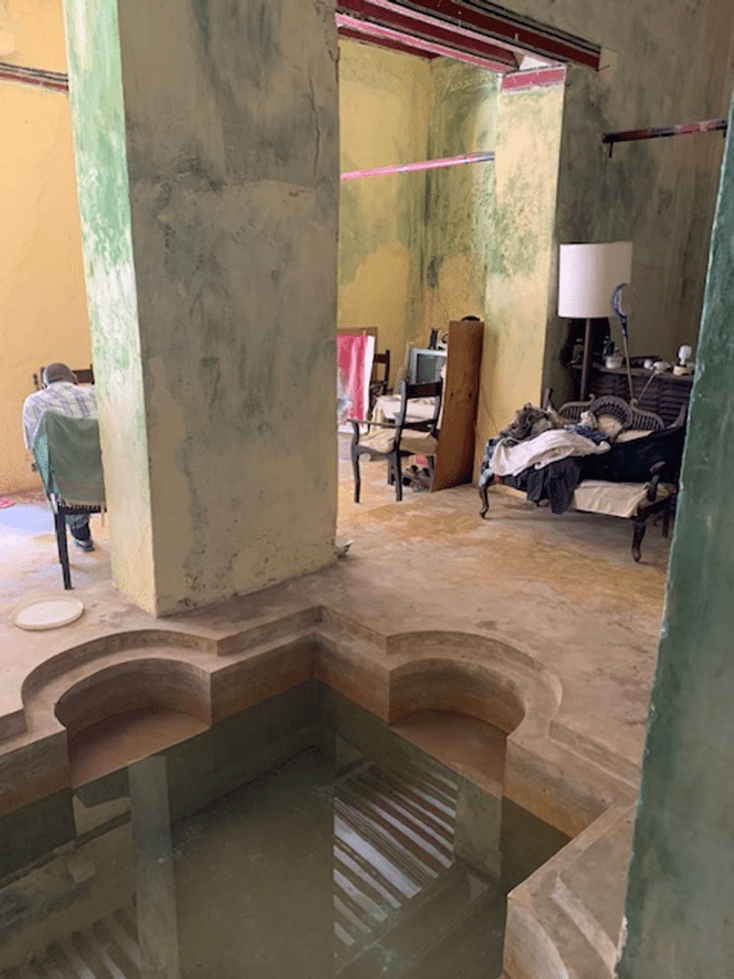
After the awesome history lesson (which I have not yet wrapped my brain around) I asked to see ‘Katherine house’ because Terry and Lew had stayed there and seen that it is for sale. Our guide said that he knew it well, that many foreigners were selling right now but that he couldn’t get into Katherine house itself so he would just take us there to see the outside. He took us first to a very traditional Swahili large house – with a big courtyard and many residences (which didn’t have doors only curtains). Here is the family bathing:

The kitchen was in ruins and on the top – 4th – floor, being hot. But because of the traditional thatched roofs they had had a fire and needed to replace the roof with rolled sheet metal. One more fascinating detail struck my fancy, the traditional ‘shelves’:

It was also very cool to see that their private well had openings on each floor – all the way up. Though I didn’t take a picture of that. If you don’t have your private well, then you have to go somewhere and buy water in plastic buckets in Lamu. This estate (apartment building) was also for sale for $250,000 but may have a Black American buyer lined up. It needs at least half a million in repairs but is still amazingly charming.

Prayer time came and our guide (named Ali) dropped us at Subira House (an extremely posh hotel) for a drink, while he went for prayer. There was a sign on the door saying they were looking for a new owner and I asked our waiter (a young man from Andrew’s upcountry neighborhood, so Luo, Obama’s tribe) to show me around. The building was the Zanzibar governor’s old home (though the governor himself was ethnically Omani) before they had to leave for the British in the mid 19th century. It is gorgeous: three courtyards, one for each of his three wives of course; thirteen gorgeous rooms and many public lounge spaces. Like Wow !!!! My pictures didn’t do it justice but here is a website: https://www.subirahouse.com/

I really ‘feel’ that place and want to move there! Perhaps I should be the Omani Governor of Lamu (I have always been ambitious after all). This ‘compound’ is in the heart of the old town, so outside is dirty and crowded, andthe hotel is tucked right up behind the old fort which the British made into a prison, as it stayed until 1984. The houses tucked into the tiny claustrophobic roads of Lamu are often spacious and gracious, with their rooftop gardens and frangipani trees, personal wells and servants’ quarters. It again occurred to me, that with women observing purdah – home is the lovely place to be, and the streets are for donkeys and businessmen. Not Gracious.

But at least there is no room for cars in Lamu, they use donkeys and bicycles all over the island. But sadly motorcycles are making headway.

An interesting feature we also noticed was that there is a thick wall with an alcove holding two benches beside every front door in town: they are much cooler than the narrow dirty roads because they are tucked into the thick corral stone walls in the shade. When you go visit your friend, you are not allowed into his home because he presumably has daughters, so you wait at the front door and y’all sit and chat together, he doesn’t invite you in.

This detail goes hand in hand with another thing I notice at the Subira House where we stopped for ice cold juices while Ali went next door to the mosque next door to pray. A woman (employee) was walking around in a very light cotton colorful house dress that I wouldn’t feel decent in because it looked like a night gown. But when I saw her I thought ‘ah yes this is the African nude zeitgeist, more power to her, she can still be comfortable in this heat’. Then she had to run out for an errand….probably to go pray across town at the woman’s mosque, and she put on one of those horrible black burkas and a black scarf to head into the hot streets.

80 percent of Lamu is Muslim and 20 percent is Catholic, and its Ramadan. I talked to he Luya man who showed me around Subira house about how I would refuse to wear black in that heat. I said I would cover up in white cotton if needed but not black silk and he said “yes its like the men are punishing them for being women. They didn’t do it on purpose”. I thought that was insightful and I often think that men want to punish women for our power over them, but that is a different article.

There’s the poor woman who made us talk about burkas.

Hotel rooms at the Subira house cost about 100 dollars a night, and there are 13 of them…..the present owners are asking for 200 million Kenyan shillings, which is somewhat less than 2 million dollars. It is a well-functioning business of course. I immediately fanaticized about my dream of a ten-person commune.  We could each pay 1,500 dollars a month for the next 25 years. This would obviously be complicated; but it is theoretically possible. And a girl can dream right?

Anyway, After breaking open my heart into retirement home fantasies, we continued onto to the main square in town. It has a big old fig tree in the middle in front of the fort that we didn’t go into and the square was named for meeting ‘under the tree’….(just like Paris used have a big old oak tree for law officiating in front of l’hotel de ville).

At one point we were walking near the Madaraka (Muslim school) at closing time and a burka clad woman was walking her son and daughter home, little girl all enrobed as well, when they stopped to look at me (fully white people are rare) I said hello and they took my hands to kiss them out of respect. I had heard that old Swahili was very respectful of older people but that one blew me away. They were so terribly sweet and gentle that I almost cried.

We stopped by a silversmith who saw my white skin and smelled blood, his stuff was pretty though and he let me look for free. He even showed me how he buys silver in powder form to make his earrings and statues. He runs the store front just like his grandfather did before him.

You gotta love a place that is so old school and traditional, while being quite laissez-faire about the tourists and new residents. Just chill and comfortable with what it is.

Obviously, I did love Lamu though it is very hot indeed.

Welcome to America

I left my Paris apartment on the evening of Dec 7th and went to CDG airport to stay at a hotel and get on the plane early enough to get to London Gatwick airport early the next morning so that I would have time to meet my daughter Sadie and get on our Norse Air flight to Las Vegas that midday. We would arrive that same afternoon of the 8th of December. We rented a cheap hotel for that night so that we could pick up our Dodge Caravan the next morning, all tricked out with a bed in back. We planned to use it as a camper van for our two-week driving holiday.

Sadie had found the really cheap airfare from Londo to Vegas and then schemed up a road trip so that she and I could see the Grand Canyon and Monument Valley on our ride down to Albuquerque to see her cousins. We talked of going to Tucson as well to see some old friends but our plans worked out differently.

First, my flight from Paris was delayed because of the storm that had just devastated western Britain. I boarded our EasyJet and we were all ready to take off when the captain got word from Gatwick that we should wait for ‘up to an hour and a half’ before taking off. The crew tried to downplay the delay but I made them explain it to everybody clearly over the loud speaker because people were not understanding. I was typical in that I had only given myself 3.5 hours for the transfer at Gatwick. Predicatbly many became concerned over transfers; I called Sadie (our booby prize was being able to use of our cell phones) to tell her the bad news. Of course, she had got on a 5:00 am bus out of Bristol in order to get to the airport on time – so she was standing by. She tried to take care of business for me, but Norse air had no online check-in and couldn’t let her check in for me until I was was standing there physically. Meanwhile, Gatwick was a zoo because so many flights had been cancelled the night before, so poor Sadie ran around trying to be helpful, and only ended up paying an extra sixty pounds to check her bag and then an extra forty to sit next to me, which they wouldn’t allow after all so she is still working on getting that money back. Customer Service was not on their priority list.

Luckily though, I met and chatted with a young Lebanese man in Paris who was also going to Los Vegas, so he and I made ourselves feel better about the chaos at the airport. He also informed me, with tears of joy in his eyes, that Asad had been ousted from Syria. …..effing finally!!!! The young man’s family were refugees to France and he now had a good IT job that was paying his way to Vegas for a conference. He said it was the last time he would use cut rate airlines like Norse.

I did meet Sadie in time and we decided that if we ever do a trip like this again it would be important to give ourselves a full night for any international ‘self-transfer’.  I am old enought to remember when international air travel was considered somewhat classy and when they pampered us; now days tt is very like being exported beef to be slaughtered on arrival, but we made it intact. And our adventure began.

Upon arrival at Reid International Airport in Vegas (perversely at 3 pm, though it had been a 10 hour flight and we had left at noon), I wanted to get a taxi to our Days Inn hotel “near the Strip”. We saw no taxi stand, and it was hard to figure out how and where to get the Uber. Luckily Sadie had the app and we followed some other incoming tourists to a strange parking spot a long walk from the terminal….

Neither of us could get our foreign phones to work for a while either. But ultimately Sadie got it figured out. I could have called Bolt except that Bolt appears to not work in the USA – where it’s Uber or Lyft exclusively I guess. Live and learn.

Eventually, our Uber did finally show up, and as if we all knew exactly what he was doing he texted us ‘Hi’ instead of telling us where he was – but we did have his license plate number and we found the car well within the zone of a normal place to be.

But the driver was being harassed by a man in a ‘gillet jaune’ – as the French called their demonstrators who wore the same ‘high viz’ yellow vests. We walked up and said hi and the driver said “the trunk is there” as he rifled through his papers. The parking guard said “find another uber”. But we put our bags in the trunk and got into the car because we had already paid and it was too late to cancel.

Then we waited as the driver, with a strong Hispanic accent, repeated how legal he was and how he just had to find his proof. The gillet jaune, a bearded, black man, was clearly losing patience. Then words were exchanged and I thought of pulling on my [old school marm’ energy to break up a fight. But I decided that in the land of free guns I should stay quiet. Sadie meanwhile was being charged by Uber for keeping her driver waiting so in her exasperation she said “Welcome to America” loudly enough for both the young men to hear. The gilet jaune guard wrote a ticket for the driver for not having his work permit ready to show. The driver didn’t want to have a ticket, and kept saying “I am legal” in such a way to make me believe he wasn’t. Then the guard said something like “this is my country and you have to follow our rules” and walked away……YUCK.

So the driver drove off with his parking ticket and us in the back seat. Sadie and I had decided to speak no more because we were just upsetting the peace accord – two men having a pissing contest in front of two women, seemed all too classic. My first impulse, after years of experience in Kenya, had been to offer a bribe but that would have been pretty bad I think.

Luckily, I personally didn’t see how upset the driver was as he left the scene of the rumble.  He was rubbing his eyes and taking his hands off the steering wheel while driving: I would have screamed, but Sadie sagely asked “you alright bro?”. This was clearly what the driver needed to hear, in order to keep driving with his eyes open, and thus get us safely to our hotel. But it undammed a flood of inappropriate reactions to the parking guard personally and about America vrs Cuba in general. It was unpleasant to hear all his vitriol (including discussions of how regularly the guard ‘got laid’) but ultimately he did drive us safely to our hotel. Sadie asked for our money back on the ‘keeping the driver waiting’ front – but I don’t know if she got it.

In retrospect that nastiness between to the two hustling young America men sorta symbolized the debacle that is American culture today: they were each frantic and not comfortable with their lives. The yellow vested man may well have been targeting the immigrant driver and looking for trouble – we noticed that our driver was certainly the only one getting this kind of hassle. And the driver, in his own right, was not taking the rules and regulations of the Harry Reid international airport seriously, for whatever reason.

They were both rude and both had their hackles up, ready for a fight. It felt like a tinderbox.

Our hotel was fine, in a typical 1950s motel style, with our parking space right in front of our door.  Our room was complete with two queen-sized beds, a refrigerator and a heater that we were able to turn on. But I did notice that I don’t like American shallow bathtubs, without a handheld faucet for the shower. And the toilets are much less efficient than in Europe as well. But breakfast was free and okay, a pastry and a cup of coffee, but also an orange and a pouch of instant oatmeal each.

What was a bit jarring was that our room was directly under a huge billboard – like three hotel rooms big – that said: “Injured at a Hotel?” in huge letters followed by a local number. If that billboard had fallen we would have been seriously injured, that’s for sure.

Welcome to America.

Ol’ Widder Woman

I am presently on a road trip in the wild west with my lovely adult daughter and yesterday Sadie reminded me of the “ol’ widder woman” we were lucky enough to cross paths with on a previous road trip from her childhood…..

In the summer of 1998, we drove from Seattle, Washington to Washington, DC in our ‘new to us’ Ford Taurus station wagon with Sadie, aged eight, and her big brother, Terry, aged ten at that time.

But back then it wasn’t just a road trip like I am enjoying now. Back then we were moving home from South Asia. My husband, Lew, had given up his job in Dhaka, Bangladesh because he wanted to return home to be nearer to his aging mother. (I too had given up my budding career, because he had promised his mother, who wouldn’t leave Florida, that we would come back to be near her soon). Lew had no job lined up yet in DC, but we had a house with a mortgage so with the courage of an unchecked youth (he had always succeeded at life) Lew knew he would find another job in a timely fashion. He was right of course! But it was only during our drive across the whole American Continent with two kids in tow, that the next job materialized.

After 18 months of living and working in Dhaka, Bangladesh, we had flown back to the USA to return him to his brilliant career in the US DOE policy office. Unfortunately, the job was no more waiting for him because of government had downsized while we were away. But Lew was looking to work with a government contractor, as did many people. These ‘contractors’ did much of the government’s work like research and policy analysis but often for higher salaries and without the claimed US Gov. job security. They were called Beltway Bandits at the time. Now that he had third world experience – Lew was in a good position to work at a global ‘think tank’.

We flew from Dhaka to Seoul to LA to Seattle in July of 1998 and then landed and spent a couple of weeks with my two sisters in Seattle. They, of course, welcomed us warmly and hospitably, and they helped us choose a good family car for our return to suburban life in the eastern USA. We started our ownership of the Ford Taurus by demanding a cross-country adventure of her, and we expected it to be fun. We would have a cultural experience for our newly returning American kids.

Sure, enough our new car faced some trouble in a mountain range whose altitude hadn’t impressed us enough somewhere in central Montana. The car got ‘an air lock’ (if memory serves me). So maybe we stayed for an extra day on that mountain side.  We fixed it, and mostly our little Taurus station wagon served us very well.

But our whole trip from Seattle, driving across the vast, arid planes of the ‘mountain states’ we noticed that we saw significantly more Harley Davidsons then we had seen two years previously. At first, we thought maybe Harley was just more popular out west than back in the east. But as we got to western Montana we figured they must be doing some kind of a big promotion in Montana and Dakota and everyone was cashing in. After the little lawnmower engine ‘baby taxis’ of Bangladesh and India, Harley Davidsons sure looked huge! And they made a lot of noise as well.

Remember this was before there were google maps, so we had picked up one of those highway atlases: a big book with all the roads drawn onto each of the states, and we were running from that. We checked it constantly. (my guess is that it didn’t show altitude however, which would have been how we got into the car problem in Montana.) We planned our trip by looking about 500 miles ahead each day to try to aim for a town that would have a Motel 6 – or any cheap lodging opportunities – that were family friendly. We would simply drive there as quickly as possible so that we could book in before they were full. If we found nothing we kept going until we did. This plan was working for the first few days of our trip. We stopped in Colfax, Washington and saw my grandmother for what would prove to be the last time. (She, in her dotage, was very happy to think that my husband was her son, I was her daughter-in-law and our kids were my older brother and sister returning from their time in Africa, from 50 years before. What goes around comes around I guess). Then we played in the Snake River and didn’t get much past it on our second day out of Seattle.

We did stay at a Motel 6 somewhere. It had a big poster of the Taj Mahal at the entrance saying “Yes but do they have HBO and ESPN?” Sadie asked what HBO and ESPN were. The receptionist explained about TV channels and got Sadie’s dander up – so my 8 year old blurted out “the Taj Mahal isn’t a Hotel, it’s a mausoleum. I’ve been there”. Now the receptionist was pissed off at our uppity daughter and she told me about Sadie (assuming, I presume, an overactive imagination). I had to back my daughter up with an explanation that we were moving back from 2 years in South Asia. The receptionist didn’t like us after that.

We also visited Yellowstone with many ‘bear spottings’ and lots of ooooohs and aaaaaahs at the hot springs. But we pretty much drove straight through.

I remember distinctly that dinner almost every night of this particular exploration of America was at a different fast-food restaurant. “Oh we haven’t tried Taco Bell in two years”….. I swear we gained at least 30 pounds between us four over our week of traveling.

So in early August, we found a town in South Dakota on our map and aimed to stay there that night. I was intrigued by its name, though I had never heard of the town, because I have a friend whose maiden name was Sturgis.

And the Harley Davidsons just kept on coming. At one point we saw about ten coming towards us across the divided highway only to be passed by at least a dozen more in a sociable clump on our side. Granted this was high summer which would be a good time of year to take out your ‘vroom machine’ but still somehow the whole Harley invasion was really getting weird!

As usual it took longer than we had hoped to drive our 500 miles and by the time we pulled into the tourist office that evening, it was nearly closing time. None the less we confidently pulled into the parking right out front. By now we had seen all the camping going on around the edge of town, and figured out that something special was going on for Harley Davidsons in this small town. Still we parked in front of the office of tourism and I ran in, Lew stayed in the car with the kids and I asked for a hotel nearby.

The man laughed in my face and said “Haven’t you ever heard of the annual Sturgis Harley Davidson Rally? There is not a room in town and any campgrounds are full too. Just keep driving.”

“Oh” says I “We couldn’t camp anyway. We have two little kids in the back seat of our station wagon and we are stone tired. How far is the next town?”.

He clearly felt sorry for me as he said it was at least another two hours on the highway. Then he paused and said: “Wait a minute. I know an old widow woman in a double wide. I bet she can make room for you.” Now was my turn to want to laugh in his face, but I was clearly excited and promised no Harley Davidsons as he called her.

“Well, she already has somebody staying at her place but she likes kids so she says head on over and see if she can help you guys out”. I felt a bit like Hansel and Gretel coming upon the house of in the woods.

I guess her “double-wide” had three bedrooms even if it was a trailer home because she had one room for herself, she had already booked her second room to a couple we never met, and Lew and I got the third room. But she kindly let Terry and Sadie sleep on her sofa in the living room. They remember her parrot and really enjoying trying to teach it to speak, but to no avail.

I think we unloaded our suitcases, then went out to dinner. By the time we returned ‘home’ to the ‘doublewide’, it was quiet, the parrot was covered in his cage, and the other sleepers stayed quiet. The other quests left before we woke up and we savored breakfast with the “old widder woman” who told us about her life on as a Dakota farmer. When her husband had died five years earlier, she had sold the farm and bought her nice trailer and a new car. She seemed quite content with her lot. She shared her home made banana bread but the kids ate cheerios. We said we were heading to Mount Rushmore, and she sent us first to Wall drug to see the important watering hole.  She said we had to see it – being a major tourist attraction.  She liked to go down there often to meet her friends for her coffee clutch.

We got to Mount Rushmore that day and were underwealmed….somehow some presidents’ heads carved into an Native American mountain side just didn’t do much for me.

But getting to stay in the home of an unassuming, but very accommodating, American woman, proved to be an important part of our re-entry process to life in these United States. That ‘ol widder woman’ knew full well that nobody was better or worse than she was, and she made room for a family in distress as long as we paid her our fair share. She was not providing charity – but she was providing a fair deal just to be neighborly.

That attitude, and the free coffee refills at diners, are what I like best about America.

Spitting pomegranate pits into the Seine.

I am going to a full moon picnic on the Pont des Arts (in the heart of Paris) tonight. An anglophone community organizes it every month to see the moon rise. Usually, it’s either too cold or too late for ‘yours truly’ to drag herself from home, but today I will go out. These get-togethers are fun even if tonight it will be cold, it’s a super moon tonight and the moonrise should be awesome – it we can even see it despite the overcast nature of the Paris sky tonight.

I am almost always overcome by shyness at these sorts of events, so I am very grateful that a friend is joining me tonight. Most people who know me wouldn’t guess that I have a shy bone in my body – but when surrounded by people I don’t know, and unless I can hide behind a comfortable role – like that of teacher, one I am very accustomed to – I feel judged and somehow lacking. So often I drink too much – and I reserve the right to do just that again tonight. If even I feel shy – maybe everybody feels like that at these sorts of get-togethers. We all work towards being friendly and non-judgemental and yet I will make a beeline towards familiar faces and start with a nice glass of wine.

Next month, I will miss this lovely event again because I will be out of town. Soon I will be visiting my family for Christmas and January 2025 in the god-forsaken USA. It has been 18 months since I last hugged my nieces, and they are growing fast and changing into the lovely girls they were intended to grow into. I am consciously implanting myself into their young lives these days.  This is partly because I remember the old Jesuit saying: “give me a child until he is seven and he is mine for life”. Also there is a good chance that I may never have grandchildren – aside from all of Kawangware Education Center that is – So I want to give some of myself to these young people who are blood relations.  

I wouldn’t want to be a child in America today – but I do trust that these girls’ parents are doing a good job teaching our girls how to feel safe in this difficult world. We have to trust them to bring us all to a better future, and I strongly believe that knowing their roots as they build their own wings is critical. I look forward to teaching the oldest of these little cousins how to make her own healthy and delicious food. My grandma taught me quite a bit about nutrition and preventative health – despite my lack of interest in the topic as I grew up. I hope I can enlist Miss Mae’s interest with some fun Christmas cooking: crepes are my first target (banana and Nutella should light up her socks as a filling).

If I’m honest I should confess that I am quite scared of spending a long time in the States. Before this latest electoral catastrophe, we also set up a camping tour of the Grand Canyon, and much of the Southwest with my adult daughter. We will both land in Los Vegas and rent a makeshift camper station wagon to do a two-week tour in December. Sadie has not yet seen the Grand Canyon or Sonoma, Arizona and I have never seen the Monument Valley or Joshua Tree National Park. So this will be an adventure indeed. We will drive around for two weeks then return to Sin City in time to fly to Austin for Christmas itself.

Meanwhile I am still grieving for the once United States. I remember a kinder gentler place from my childhood. I swear I saw only one homeless person when I lived in West Lafayette, Indiana in the 1960s. We were being driven to school by my mom and I saw that across a field was an abandoned school bus – in the telltale yellow that was always used for school buses. I must have asked Mom why it was over there nowhere near a road because she explained that a family with no other address lived in there. I was shocked because they obviously had no plumbing nor heat in that home, let alone a postal address. I was calculating how at least school had lunch and was warm for the kids, I would have gone silent for the rest of the ride to school. So much to think about.

Meanwhile, we are supposed to bring our own food and/or something to share to this moonrise picnic. So I thought I would bring a sandwich and a drink. Then I saw my pomegranate sitting there unloved and I decided to bring it too.

I love pomegranates but they are a major bother to prepare. In California, at Whole Foods or even Trader Joe’s, I loved to buy them already cleaned out into just their kernels – and I know many people happily swallow the seeds. But I don’t like to do that.

I remember the first pomegranate I ever saw: Pomegranates are a sacred food in much of the world but in Indiana they were just incredibly exotic. My dad brought one home once on a cold winter day. The whole family sat at our Formica kitchen table and shared it for a snack. I thought it was terribly ugly at first, until they opened it up and I saw the kernels inside which are each like a tiny ruby. I fell in love. But I didn’t like the dry seeds inside the rubies at all – so I ignominiously spit them out and was warned to be careful not to stain my clothes. Anamaria is six years older than I, and she somehow magically knew how to eat the messy fruit. But Anamaria always knew how to do everything right: she made the best Easter eggs, Halloween costumes, delicious dinners and she even taught me my numbers. I remember she taught me one to nine and then told me to start piling the numbers up – I was pissed off that there was no new cool squiggle for ten. To this day Anamaria is blessed with much more grace than I will ever master.

Much later, I learned that it was only because of her eating six pomegranate pits (as given her in the underworld) that the goddess of springtime – Persephone – must return to Hades for six months every year and we must endure dark, cold winter, without her sunshine.  Anamaria recently explained to me that according to the Bible – it was actually a pomegranate (not an apple) that Eve ate which damned her into learning shame and being kicked out of the garden of Eden with her hubby. Also a hand grenade is named after the french for pomegranate – le grenade. So those pretty little ruby gems have a lot to answer for, actually.

Still, they are delicious, aside from the pits, and I think I will bring one to our picnic. I will cut it up to share, and I will spit my seeds into the Seine. Sorry, Paris – I still ain’t got no class.

How Oxford saved the Lloyds

Mom and Dad met at Reed College in Portland, Oregon when they were both still teenagers. They were married and my sister, Anamaria, was born before Mom turned 18. This was less shocking back in the 1950s but still not a very auspicious start to the Lloyd family life.

Mom obediently dropped out of school – her dad wouldn’t pay expensive tuition if she was just going to sleep with boys. And of course, Dad couldn’t afford that tuition either once he was married and raising his daughter and supporting his wife.  My parents moved back to his parent’s home in Colfax, Washington and into the hotel that they ran.

During Anamaria’s first of year of life however, both her grandfathers died and her Dad’s family hotel burnt down. Not an auspicious start to Anamaria’s young life either.

And yet, both my parents were smart, strong (perhaps spoiled) only children and both their mothers kept right on helping the young family thrive. So, we kids started with three moms and one dad. I understand that my father’s mother gave them a monthly stipend for years after they were wed – well after their fourth child was born – and my mother’s mom came when I – their third child – was born to help as needed.

But as a teenager, my dad continued taking courses at Washington State University while my mom had a second child in Pullman, Washington; Clifford became my older brother. She had a very difficult delivery – breach birth – so they gave her blood transfusions because of her heavy loss of blood. She was convinced for the rest of her life that this blood had been tainted. Remember, 1958 was well before they were testing donated blood for hepatitis after all – My mom was convinced she caught Hepatitis from her transfusions. She was too sick to get out of bed for months after my brother was born. Meanwhile, my dad was doing well at school. As an undergraduate he met a distinguished professor, Bob Clawer, (who later went on to become the editor of the American Economic Review) who had been a Rhode’s Scholar and was very impressed by this local boy. My dad had a spark of something special: a great sense of humor, mathematical genius, a fabulous singing voice and great people skills. Not only was he very good at math but he was also good at translating math to life, so he saw that it worked very well to explain Economics. Meanwhile my mom remained sick.

Dad graduated in Washington State and Prof. Clawer sent him up to Northwestern University in Chicago to get a Master’s Degree. But my mom stayed sick, and the kids kept growing. My parents did a short stint as a moving company for one summer – one truck and two adults to carry stuff made them some much needed money. Both Grandmas had stayed out west and though my dad did well at school, the family wasn’t quite thriving.

Prof. Clawer must have really taken my dad under his wing by this time because he thought of Dad when the professor heard of an academic position is Africa. His clever plan was that my parents could take the kids with them to teach in Khartoum – Dad would teach math at the University in Khartoum and Mom would teach English at a girl’s high school. Everyone figured that the warm weather and the house help would really help the little ones and my mother would be able to rest enough herself to get over her mysterious illness.

Well not everyone was thrilled: my dad’s mom was not happy to lose her son to the tropics – and so far away ‘just to be a teacher’, but my mom’s mother thought it was a good idea….generally she thought following the paying job was a very good idea.

The young family took their first mid-term holiday with a safari: my adventuresome young parents (who still believed they could do whatever they wanted in their lives – the bravery of naive youth) took a boat from Khartoum to Kampala and learned a lot about ‘deepest darkest Africa’ – for example my toddler brother walked off the boat into the Nile and local swimmers had to fish him out before the crocodiles did – though he did get dysentery from the adventure. Luckily, an older German woman explained to my mother to give him yogurt, which was something she had known nothing about in the USA at that time. The old adage that ‘It takes a village to raise our children’ comes to mind – especially if you have a couple of foolhardy teenaged cowboys as parents.

They met lots of local people along the Nile and their stories colored my childhood: Mom told me the story of being begged for antibiotics as they passed though, by the chief of a village because a young man had been mauled by a hyena the night before. My parents said no because they were still traveling with two young children and wanted to be able to treat them if something went wrong. I think this was hard for the well-meaning young couple. They had less trouble turning down the offer to purchase a leopard skin – because it was for sale for a whole pound sterling and that was a ridiculously expensive price.

My mother also told me story when I was about ten years old: “We were traveling down the Nile, and we had a translator to help me interview the local tribes. I talked to one man from a small group of people and asked him if it was true that his people were cannibal like the rumors said. He got the translator to earnestly explain that they weren’t cannibals at all ‘but if somebody dies, we don’t waste him’.  She had told me that story as a lesson in not wasting, but I believed it literally enough to share it with a university class in cross cultural understanding years later. Before she died Mom told me that this was only a joke. Whoops – Professor Fulton passed on fake news in the early 21st century, I guess.

But back to the colonial outpost of Khartoum – my folks thrived on the adventure – aside from the baby mom miscarried at 4 months along. There was another uncomfortable social dynamic in Khartoum: that they were treated as slightly lower-class citizens by the posh brits. For example, Mom was a wee bit insulted by the boxing day tradition of giving the Lloyds their already half eaten ham. She fussed years later “It tasted good but really, we didn’t need their handouts”.

Anamaria distinctly remembers not wanting to learn Arabic in Khartoum, because as a toddler herself – she was treated as a mere female by the solely Arabic speaking servants. Meanwhile her kid brother could do no wrong in their eyes. She knew at the age of 5 years old that this was only because of his possession of a penis, and she felt cheated by the language and the culture it promoted.

Well, it turns out that my dad was a very good math teacher.  He is supposed to have ushered through some of the best math scores in the world from his central African university. In fact, looking at the exam results out of Khartoum, Oxford was suspicious that cheating was involved. So they sent some Fellows down to Khartoum to check out what was going on.

My parents were not your regular sports club expats, and the Oxford Dons were impressed. They found no cheating from my Professor Lloyd’s class; so they asked him to come teach ‘Maths’ at Oxford. He was less impressed: “I’m fine here – why should I go to that cold stuffy place?” So they sweetened the pot with an offer for him to do a Doctor of Philosophy in Economics. This was exciting. My Dad had thought of himself as potentially the next Woody Guthry, but being an Oxford Don also sounded good. So, after four years in the colonies my parents were taken under the Oxford bubble by and for the world’s lucky few.

After her miscarriage in Khartoum mom got pregnant with me upon arriving in Britain. The doctor said I would never be born and that she would never carry another living baby. He also prescribed thalidomide which may could well have fulfilled his prophesy, if she had taken it, But she didn’t.

She did what any crazy 24 year old mother of 2 – with an added foster child – would do, she persuaded the Oxford faculty to let her do a Master’s Degree even though she had never finished college in the USA. Life experience worked for something back then, I guess. She studied under the famous anthropologist E. Evans Pritchard, because she had first hand knowledge of South Sudanese ethnic groups. Once one of her dons asked her why she was never properly intimidated by their authority (I believe he said “why aren’t you scared of me”). Clearly students were supposed to be cowed. Mom responded “I guess it’s the Rodeos I used to do”. My mother knew no fear of consequences. I can’t remember my father’s relationship to fear – but I know he had a healthy respect for hard work (which may have been fueled by fear).

Obviously, my parents looked like Nobel Savages to the Oxford Elite. To top up the ‘upstart colonist’ image – We lived for some time in the same house as Monmohan Singh – who later became Prime Minister of India – We passed children’s close back and forth between all the kids in the house. I remember with pride my rabbit skin coat that Monmohan’s daughter passed onto me. Interestingly Mr. Singh never wanted to be in Politics – all he ever wanted was to be an Economics professor, like my dad became.

It turned out that I was born in July after all: healthy except for recuring bronchitis. Mom still had to do her exams when I was a less than a year old though. So she called her own mother to come and help out. My Meme never really left. She became the stable parent I knew for my whole childhood.

I have been told that during my first year of life Dad fell in love with a woman in London – I don’t have the details on that but he supposedly told Mom and us kids that he was leaving us all in the capable hands of my Meme.

But the Oxford University of those days wouldn’t allow a professor/graduate student to abandon his wife and three children and still get his stipend. So dad dutifully returned to Oxford and my parents stayed married.

I guess Meme worked as their marriage counselor too. I also know that Mom took me (as a babe in arms) and Anamaria to Paris and then to St. Malo to find her cousins, since her grandfather had emigrated from Alsace. To this day, this family relationship is still a source of great value on both sides.

When I was two (and my dad was 28 years old) we moved back to the USA, where my parents both taught at Purdue University and had another child together before splitting up for good.

As they say the rest is history. Though in this case it is ‘my story’ – or “herstory”- and I will continue soon. It is certainly much richer for our Oxford jaunt and I am incredibly grateful that my accidental British passport got me residency in France (before Brexit).

About Time

Is it true that we are just killing time until it kills us?

What even is time? Einstein taught us that it truly IS completely relative. But we knew that! Those ten minutes in which you are getting your teeth drilled last a great deal longer than the ten minutes in your bath. Time is weird. Time is also culturally defined.

Africans have a very different take on time then we Europeans do, and I have to admit that I often like their view better than ours. Time is not money in Africa (except maybe in the board rooms of Nairobi, Johannesburg or Abidjan). Time was nothing at all to the Ghanaians I met fifty years ago. We were all just swimming around in it, just like the air we breathed.

I remember clearly as a young girl my shock when a grown man got up from talking to me and walked away as he said, ‘I am coming. I am coming. Wait small’. I was mad and wanted to scream at him. Why should I ‘wait small’? One thing I never wanted to do was to spend my life waiting for time to pass. Ironically somehow, it seems that those less time driven cultures actually spend less time just waiting then do we clock bound folks.

In 2006 in Nairobi, I once got to a wedding 7 minutes after the time stated on the invitation – we had been stuck in traffic. When we walked into the church, they were sweeping the floor and we asked if we had missed the ceremony. (For our marriage bacj in Sudbury, Mass our church had done 7 weddings in one day so we could easily have missed our own ceremony if we had been late) The Nairobi cleaners laughed and said that No we were not at all late, but they wouldn’t explain further. We were the only people in the church then, for two solid hours after they swept. Somehow everybody else knew to meander in really late, and the bride showed up three hours after the invitation stated, along with the vast majority of the guests.

To this day I tell people in Kenya that if you want to make an American mad, just keep her waiting. I slowly bubble up into raging fury as I calculate how much your tardiness is costing me. It feels terribly rude to me as a time-centric American, it feels like you don’t take my time as having any value. But for us of course – time is money. I personally am always thinking of ways I can do two things at once to save time, or at least how I can be more efficient with my limited time. This stresses my out – and I’m sure ages me prematurely. But presumably it saves me money somehow.

In the Ghana of my youth babies were named for the days of the week that they were born on, so calendars at least had meaning. But one day’s hours of sunlight was perhaps the smallest unit of time they were willing to work with….’I’ll see you tomorrow’ was perfectly reasonable; but certainly not ‘at 12:30’!

Then in Dar-es-Salaam, in 1976, I learned to tell time in Swahili: their language systematically counts their hours from sunrise to sunset and then back again. Sunrise is an exciting, significant daily event. Every morning the dark night cracks wide upon, accompanied by exuberant birdsong, into a fiercely bright day potentially full of enthusiasm and pleasure.

In our faculty home on the campus of the University of Dar-es-Salaam we didn’t even have ‘proper’ walls. We had levered shutters that you left open all night so that you could enjoy the breeze until the sun woke you at 6 am every morning all year, and you quickly shuttered up through the heat of the day. The sunrise on the equator is a majestic and magnificent occasion that lasts about 5 minutes. It’s as if the blackness of night is pierced like a balloon and shoots away up into the heavens.

According to my memory, the Tanzanians jump up with the sun so that by moja (one o’clock in the morning, which equals our 7 am) you have already got up, eaten, showered, dressed, packed your bag for the day and are already at school. By sita (six o’clock or noon for us) you were hungry for lunch; it all made sense. Then night started all over again, moja usiku ‘one at night’ is 7 pm, time to rest in the dark (from pre-electricity days) and probably play some music or tell stories to your family. Of course, now one just watches TV.

This powerful geographic difference probably explains a lot of the cultural difference in time between Europe and Africa: In the frozen north summer days are very different from winter days, you drag yourself up amidst the mist and cold mornings and struggle out from your covers to seek the warming sun. On June 2ist here in Paris the sun shines until 11 pm. Whereas as Robert Louis Stevenson wrote “In winter I get up at night and dress by yellow candlelight”. This is not the case in the tropics!  

Of course, European Americans took their old country’s culture to the new world with them, and it meshed well with capitalism. One sells 8 hours a day of her time to her boss in exchange for her salary. I have no idea how the first nations of the Americas dealt with time (though I heard a rumor once that the Navajo used to have no word for “plan” – so maybe Joseph, and his coat of many colors, never warned their king of ‘seven years of feast followed by seven years of famine’). Being in tune with nature means no planning, no hoarding or ‘saving’, and thus hunger can come before the harvest, unless you can live off the hunting. On that note, those lucky Africans can harvest all year around, so they don’t need to go into starvation mode in the winter, like my European ancestors did, even if they haven’t filled their root cellar.

As a good capitalist American student, I learned to be on time as I grew up – first to school and then to work: ‘time is money’ after all.  The first clock was put up in Paris in 1370 (meaning one thousand, three hundred and seventy years after Jesus was born). REALLY? Europeans knew that. I’m skeptical. After all Methuselah may not really have lived 900 years, I question that too. In fact, I blame the Romans with their Gregorian then Julian calendars – they were good counters after all. I’ve heard that until they figured out the leap year concept the Romans were getting well out of sync between their seasonal holidays and the seasons in which they actually fell. Imagine the Easter Bunny in the scorching heat (oh wait that may be coming around again now with our climate change)

As Europe ‘developed’ you had to know when to be where with more precision than our seasonally defined agrarian roots had needed. The saints’ days had always been important in medieval Europe because they told you when to plant and sow, harvest and store; but not when to show up at court to see the king.

In fact, it once came to my attention that timed football games were originally established near factories not just to entertain the workers but also so that these same workers could get more of a sense of time as well. They were supposed to develop a sense of 90 minutes by knowing how long a game lasted.

That’s a good idea, maybe if I played soccer, I would have a better sense of time myself. I really can’t relate time without a clock. I must always have a time piece near me. Of course, we now have smart phones to help with that.

There was a clock on the wall, once in 1985, when my graduate class, at an expensive Ivy league University, got mad at our professor for being ten minutes late to our class. To our credit – it was criminal how much we were paying per class hour each term. We had done the math, and we didn’t want him shortchanging us. I’m sure the professor wanted to stay late but we all had jobs to get to so we couldn’t wait around.

I sometimes think that I have been using time as a form of self-punishment my whole life. Certainly, the almighty schedule has run my life for most of my years. We are all slaves to Tax Day, to our boss, to our self-imposed New Year’s Resolutions with deadlines, and even to the crockpot waiting for us back at home. I know, I am always putting a deadline (even that name is horrible when you stop time long enough to notice) on my projects: ‘I will loose five pounds by my birthday’; ‘I will write to my mother on Saturday’; ‘I will jog four times a week’. These are all time-based pressure points, and now as I look down the pike at old age (predictably today, because it is my 63rd birthday) I wonder if this time obsession is still serving me.

Wouldn’t it be lovely to flow with the seasons of the earth and with our bodily needs? A girl can dream anyway: To get up when you are rested, hopefully with the sun. To eat when you are hungry; breakfast is to break the fast after all, though the French don’t dejeuner (or ‘unfast’) until noon; they eat dinner late after all. We could hunker down for a long winter’s nap with our cupboards full of food in the dark cold months and work really hard for planting and harvest in the long spring days and cooling fall season. As we age, we could work fewer hours at the office, but presumably get lots done because we know the ropes. Or we could live on less income because our homes are paid off and we eat less. Oh, wouldn’t that be lovely?

But obviously with 8 billion souls on the planet right now – we no longer have the luxury of this ease with lower productivity. Some of us used to be less concerned with efficiency, but now capitalism has us in a frenzy in which there is never enough time to do what we need, let alone want to do.

I heard a story once of how the European Carolinians (white people from N and S Carolina) were considered lazy by the capitalist powers that were setting society’s norms in the 17th century. I guess they didn’t want the capitalist hassle of buying slaves. They just wanted to relax and do their family farming peacefully without owing anybody anything. ‘No no’ it was argued ‘you need slaves to grow cotton to sell to England to get rich so you can relax on your plantation’. Capitalism has always been greedy. Under it’s yoke – If a subsistence farmer is not greedy he is lazy of course.

Now, there is the more recent story of a rich Californian who visited a poor Mexican fisherman in Baja-California. The fisherman got up early and went out to catch what his family needed for the day, he even got some extra fish to trade with his neighbors for corn and schooling for his kids. But he was home and sleeping under his sombrero by 2 pm when the millionaire came up and wanted a fishing expedition. The fisherman said no, and the Californian pushed back by calling him lazy. “Why don’t you catch more fish and sell them in the market and get rich?”

“No quiero” replied the fisherman “What good would all that money do me?”

“Well you could obviously buy more boats and hire helpers and get richer and richer”

“But por qué I’m fine”

“ But then you could let the others work and you could relax” the millionaire explained.

“I’m relaxing now” replied the fisherman.

It seems to me that we westerners think poor people shouldn’t be allowed to relax; one ought to be worried about his lack of saving’s account. We must always want more than we have. Capitalism only really works well if we are all hungry for more.  If you don’t have a huge savings account, you haven’t earned relaxation – according to the capitalist machine. And yet I want to just relax for the next 20 years even though I don’t own a car and I can’t afford a fancy cruise and I may not be able to eat out much as an old lady.

My father died when he was 41 years old, I would like to make it to twice his age before I leave this realm, but there is no assurance of that, so I am getting a bit protective of my time and health. I will not sacrifice the latter for the former!

Is time really money, or is time all we have? When you die you will leave your money behind, but you will not leave any time behind. You will have spent it all. Our lives are no more than the sum of our days.

As the Irish say, “we aren’t here for a long time, lets at least make it a good time.”

Meme

She taught me how to play solitaire right from the start. Before I learned how to say the name of the card game she called ‘big casino’ I called it ‘Baked Cresino”. It was a game with adding and subtracting and certainly helped my math skills. The solitaire game she explained to me was always (at least theoretically) winnable. But back in the days of decks of cards we both lost often. Nowadays, it is a phone app called Free-cell and you don’t lose because you can always backtrack to the beginning.  I still play most every day in memory of my Meme. When I was little, I would wake up in the morning and run into her bedroom first thing – we would play cards before she got up to make us all breakfast. She was 65 when I met her, when I was born, and she always had time for me for the rest of her life.

Meme was my beloved grandma and she taught me everything I know, and lots I am still learning. She made that one safe place in her heart for me that I so desperately needed as a sensitive young girl in the sixties and seventies.

She was born as Irene Hill. We called her Meme though, shortened from ‘my mama’ as she was introduced to my older sister. She was the most important human in my life. Nowadays, when I meet a therapist and start talking about my parents the therapist will soon blurt out – “but why are you mostly okay?” – I always proudly say that Meme loved me no matter what. They inevitable nod their heads sagely and say – ‘ah okay’.

In 1961 my mother was told in the early throws of her pregnancy with me that I would never be born. She was also prescribed thalidomide but wouldn’t take it (I would have been severely damaged by it if she had but that’s another story). So, Mom went back to university to get her master’s degree despite her two children and one foster son at home. She wanted something else to keep her busy. But I stubbornly kept growing in her womb. When I was born and she still had to sit her exams for her master’s degree she called her own mother – long distance from Oxford, England to Warm Springs, Oregon – and asked her to come help for a while. Her mama quit her job, sold her car, and stored her stuff with a cousin in Portland before she got on the plane to  come to England and help out.

Mom and Meme fought for the rest of their lives – I’m afraid it may have been their love language. But Meme stayed steady for me as I grew up in a turbulent household.

Irene had been born in a sod dugout in Omega County, Oklahoma territory in 1898. Her earliest memory was losing her rag doll out the back of their covered wagon as they moved west to make room for the Indian reservation that Oklahoma was becoming (at least temporarily). Irene traced her people back to the German mercenaries (called the Hessians) who were brought over by England to fight the colonists. She said, “once they lost, they figured, ‘why go home?” and Meme’s practical disposition linked unapologetically to that spirit. Her parents had four girls and two boys I think, and they were not rich. They dutifully left Oklahoma and moved to Missouri when she was very young, and they continued farming. Though Meme’s mother’s (for whom I was named) father bred horses and made money from horse racing. Much later in life Meme told me that he had starved himself to death under their roof when he lost his sight so badly that he couldn’t tell the difference between a one-dollar bill and a twenty. But that is also another story.

The Hill family lived near a tiny town which had a one room schoolhouse that only went up to grade 8. So Irene repeated 8th grade three times in a row – She loved learning so much. Two of her sisters married two neighbor brothers (making ‘double cousins’) and her two brothers worked always close to the farm and the life that they knew so well. I remember visiting one of Meme’s sisters in the 1960s and getting our water from the kind of pump that had to be ‘primed’ out in the garden of her house. She had married her sister’s widower later in life but there was no shame around that…I understood that ‘keeping it in the family’ as they did had to do with ‘manning the homesteads’ of the newly broken ‘wilderness’. I am reminded of Willa Cather as I write this (though my mother never liked that author’s condescending tone).

In the 1970s I once trotted into the kitchen at a family Christmas in Buffalo, NY where Meme was grumbling as she put together our feast. She never liked Christmas much. I asked her what her family had eaten for Christmas dinner when she was a kid and she scoffed as she responded, “well corn meal much, just like every other day”.

Irene’s other grandfather had been a civil war soldier and considered himself rich in Lincoln, Nebraska, because he had cash enough to put a kid through high school on his veteran’s pension. He offered all his offspring a turn for one of their kids to go to the academy in the big city. One of Meme’s aunts had a son who had just finished high school and was heading off to Princeton to study math (and then work on the Manhattan project) when her grandpa visited Irene’s family farm. He offered his granddaughter, my grandmother, her lifeline to a much bigger existence when he took her to live with him in Nebraska. I love to tell this story to Europeans and Africans because it points out just how precious frontier women were. Their talents were not to be wasted – if a girl had potential to learn she was cultivated as a valuable resource that the greater society needed. The Hill family of Missouri were hillbillies all the way, but Irene was smart and given a chance to an education. She paid that forward many times by becoming a teacher for the rest of her life. When she retired at 65 to take care of me, she left a job teaching 5th grade on an Indian reservation in Oregon which she had found to be terribly hard work.

In fact, fast forward to my school days and she taught me to read despite my dyslexia. I was not a quick study even though my IQ test results said I was smart. My grandma’s patience was priceless to me. I remember thinking how ugly the word ugly looked on the paper as I learned how to read it and Meme saying “I never thought of it that way but I see your point, it is not a pretty spelling”.

But back again to the WWI – Irene was a single teacher living in Lincoln, Nebraska when she was pointedly not invited to the knitting bee where the ‘cool girls’ were knitting socks to send to the troops in the trenches. She showed up anyway, and proudly stated as she walked into the silenced room that “one volunteer is worth two conscripts any day”. I took that hutzpah to heart – even though I didn’t have the language to call it hutzpah when my grandma told me her story.

My Mom used to tease her mom about how Meme didn’t know enough to wipe the water off the kitchen floor after washing the dishes. Mom said it was because Meme was used to a dirt floor. Meme said that we had her braided rag rugs which wiped up for her – though I remember thinking that the nylon stockings that Meme had knit into rag rugs weren’t very absorbent. They were certainly better than nothing. Meme was not a perfectionist. She was fond of saying, with an exaggerated drawl, that it was “bettr ‘en it were”. I carry that saying forward to this day for when I have done enough.

Meme lived with us on and off for my whole childhood. Mom would periodically kick her out of the house though, even while Mom was divorcing my dad and/or marrying my stepfather. Meme ran the household. I remember when I was seven years old  a man tried to take me away in his car as I was walking home from school. I knew enough to run all the way home. When nobody was home, I knew enough to run to Meme’s apartment a couple blocks further and she called the police. They called my dad from work but I couldn’t describe the man at all: “how big was her?”,  “grown up sized.” “What did he look like?” “a grown-up man with brown hair and white skin.” We didn’t have the term ‘latchkey kid’ in those days but I was safe after all. And that day my dad and grandma both hugged me and told me I was brave.

Meme had raised my mother, her only child, while traveling all around the west – either with or without my granddad. He was a mining engineer and had lots of ‘gig work’. So Mom was a latchkey kid herself. She had had trouble learning to read as well, before anyone knew what dyslexia was, and hers was exacerbated by changing schools often. But her mother finally taught her at home when Kathryn was in the 5th grade. My Mom never internalized a concept of being stupid, rather she got very cross with the ‘see and say’ method of teaching reading. Mom and Meme agreed on that.

When WWII broke out Irene took her eight-year-old daughter to Portland, Oregon where both parents worked full-time for the war effort – Irene became ‘Rosy the Riveter’ for the duration. Mom’s fondest memory of her own childhood was sitting on her dad’s lap and listening to the war news on the radio every evening. He had been a WWI veteran and explained everything to his only child even if she was a girl. But Meme didn’t have a fond memory of factory work.

My mother was raised without religion and she laid Catholicism on her five daughters in an almost punitive manner. Once I asked my mom and grandma to become Catholic for me. Mom refused but Meme acknowledged that ‘religion is good for immigrants I guess’ implying that we solid Americans didn’t need that crutch. Later in life however, I brought up religion again; Meme clicked her cheeks and said “whelp, I’ll tell ya. There’s more to life than meat and potatoes. That’s all I know.”

After I graduated college and went to work in Europe for a year, my then boyfriend came over to hitchhike around with me. Meme told me on a long distance phone call that “back in my day, nice girls didn’t do that sort of thing. But you’re a nice girl and you are doing that so I guess that times have change”. What a vote of confidence I felt.

Meme lived long enough to see my son be born and to tell me that he needed a sibling. She said that he was too sociable to be an only child. She said she knew that being pregnant was hard for me, she herself had only given birth to one child; having told me when I, as a child, and asked why I had no aunts or uncles ‘we could have had more children……. but we were careful.’ Mom had been born in 1936 and my guess is that her parent’s didn’t feel safe in that economy to have more kids. But Meme told me in 1986 that my son needed a brother or sister to keep him company throughout his life.

Fast forward a few years after Meme’s untimely death at 89 years old and my son and I are looking through my photo album – He called it the ‘Meme died book’ – when his little sister asked where she herself was in all those pictures. I thought I was being kind when I said ‘Sorry dear, you weren’t born yet” But she would have none of that nonsense – she scolded in here little two-year-old voice, like I was some kind of dummy: “No Mommy! I was your grandma!”

From the mouths of babes!